

Table of Contents
Imagine two websites selling the same thing. Both are well built. Both load fast. Yet one gets three times the organic traffic. Why?
Most of the time, the winner is not working harder. They are simply showing up for searches the other site never thought about. That missing piece is called a gap, and finding it is the whole point of competitor gap analysis tools.
If you are a CTO, product manager, developer, tester, researcher or digital marketer, you already love data. The good news is that gap analysis gives you a clear, measurable way to decide what to build, write and fix next. No guessing. No "gut feel" content calendars.
At Cinute InfoMedia, our SEO services team uses this exact approach to find fast, realistic wins for clients. In this guide you will learn what competitor gap analysis is, which types of gaps matter, which tools are worth your time, and a simple 7-step process you can follow this week.
What Is Competitor Gap Analysis?
Competitor gap analysis is the process of comparing your website with your search competitors to find opportunities you are missing. You look at what they rank for, what content they publish and who links to them, then compare it against your own site.
Think of it like a code review for your SEO. You are not copying anyone. You are spotting what is missing, what is weak and what is already strong so you can prioritise.
A good analysis answers three simple questions:
- Which keywords do competitors rank for that we do not?
- Which topics do they cover better or more deeply than we do?
- Which websites link to them, but not to us?
Also called SEO gap analysis, this work sits at the heart of any serious competitor analysis and feeds directly into your keyword research and content plan.
The 5 Types of Gaps You Should Know
Not every gap looks the same. Here are the five that matter most.
1. Keyword Gap
A keyword gap is a search term your competitors rank for, but your site does not. This is the most common starting point. A keyword gap analysis often reveals low-competition phrases that bring qualified visitors fast.
2. Content Gap
A content gap is a topic, question or format you have not covered. Maybe a rival has a detailed comparison page, a template or a glossary that attracts links and traffic. A content gap analysis shows which pages you should create or improve.
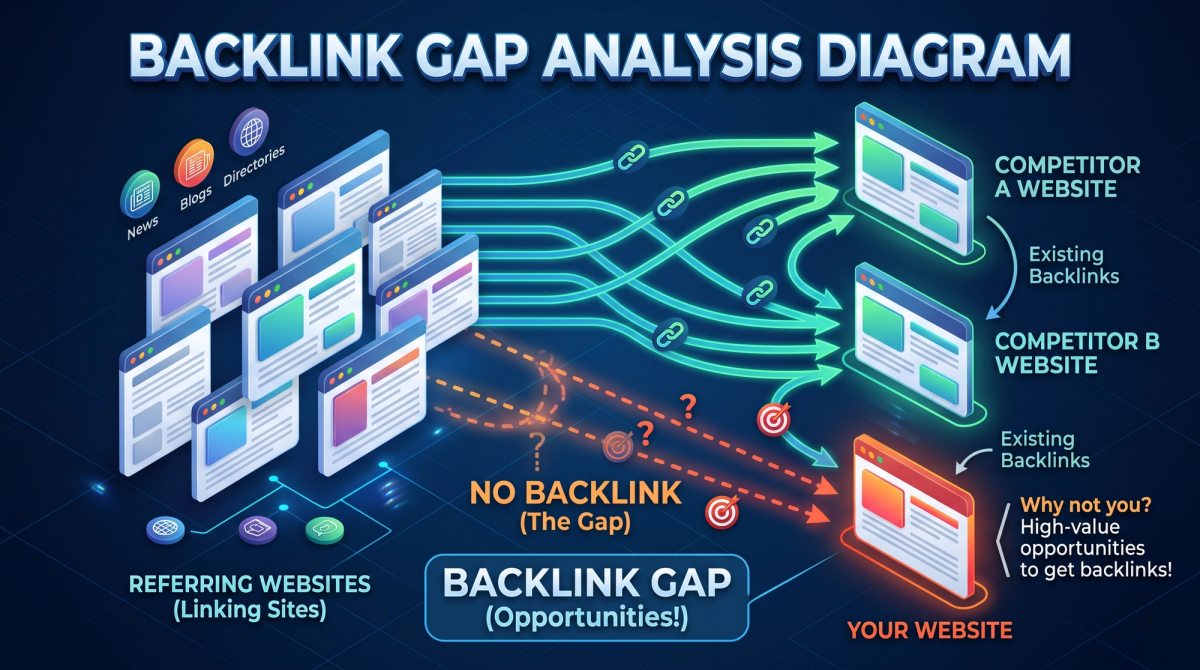
3. Backlink Gap
A backlink gap lists the websites that link to two or more competitors but not to you. These are warm outreach targets, because they already link to sites in your niche.
4. SERP Feature Gap
Some competitors win featured snippets, "People also ask" boxes, video carousels or image packs. If they own these spots and you do not, you are losing clicks even when your ranking looks fine.
5. Technical Gap
Sometimes the gap is not content. It is speed, crawlability, structured data or mobile experience. If a rival loads in under two seconds and you take five, no amount of writing will close that distance.

Why Competitor Gap Analysis Tools Matter for Tech Teams
You could try to do all this by hand with spreadsheets. For a tiny site, maybe. For anything bigger, it quickly becomes impossible. Here is why dedicated tools win:
- Speed: Compare hundreds of thousands of keywords in seconds.
- Accuracy: Tools pull ranking and traffic estimates from large keyword databases.
- Prioritisation: Filter by search volume, difficulty and intent so you work on what pays off first.
- Repeatability: Re-run the same report every month and track progress.
- Team alignment: Share clear reports with product, engineering and leadership.
For technical teams, there is another benefit. Gap data gives developers and testers evidence for fixes like page speed, schema markup and internal linking. It turns "SEO says so" into "the data says so."
Best Competitor Gap Analysis Tools in 2026
There is no single best tool for everyone. The right choice depends on your budget, team size and goals. Here are the most trusted options, explained simply. Always check each vendor's website for current plans, since features and pricing change often.
Semrush
Semrush is a popular all-in-one platform. Its Keyword Gap tool lets you enter your domain and up to several competitors, then shows shared keywords, missing keywords, weak keywords and untapped ones. It also includes a Backlink Gap tool and site audit features.
Best for: Marketing teams that want keyword, backlink and technical data in one place.
Ahrefs
Ahrefs is known for its strong backlink index. Its Content Gap report shows keywords that competitors rank for and you do not, while Link Intersect reveals sites linking to rivals but not to you.
Best for: Link building and deep competitor research.
SE Ranking
SE Ranking offers competitor research, keyword gap reports, rank tracking and audits at a friendlier entry point. It is a good fit for agencies and growing teams.
Best for: Small to mid-size teams that want solid features without enterprise complexity.
SpyFu
SpyFu focuses on competitor research for both organic and paid search. You can see which keywords competitors rank for and which ads they have run over time.
Best for: Teams who want to study competitor SEO and PPC together.
Moz Pro
Moz Pro offers keyword explorer features, domain authority metrics and link research. Its approachable interface suits beginners and teams who value clear scoring.
Best for: Beginners and teams that like simple, readable metrics.
Similarweb
Similarweb estimates traffic sources, audience overlap and referral channels. It is less about individual keywords and more about the big picture of where competitor traffic comes from.
Best for: Product managers and strategists studying market share and traffic channels.
Free Tools to Start With
Not ready to pay? You can still do useful work:
- Google Search Console shows your own queries, so you can spot pages that rank on page two.
- Google Trends helps you validate topic demand.
- Screaming Frog (free version) crawls small sites for technical gaps.
- Manual SERP checks let you see what content formats rank for your target keywords.
Free tools will not give you the full competitor picture, but they are a smart starting point.
Quick Comparison Table
| Tool | Keyword Gap | Backlink Gap | Technical Audit | Best For |
|---|---|---|---|---|
| Semrush | Yes | Yes | Yes | All-in-one marketing teams |
| Ahrefs | Yes | Yes (strong) | Yes | Link building |
| SE Ranking | Yes | Yes | Yes | Agencies, growing teams |
| SpyFu | Yes | Limited | No | SEO plus PPC research |
| Moz Pro | Yes | Yes | Yes | Beginners |
| Similarweb | Limited | No | No | Traffic and market analysis |

How to Choose the Right Tool
Ask yourself these five questions before you buy:
- What is my main goal? Keywords, links, traffic sources or all three?
- How many competitors do I need to compare? Some plans limit this.
- Who will use the reports? Marketers want visuals. Developers want exports and APIs.
- What is my budget? Many tools offer free trials, so test before you commit.
- Does it cover my market? Check database coverage for your country and language.
A simple rule: start with one paid tool, learn it deeply and add others only when you hit a clear limit.
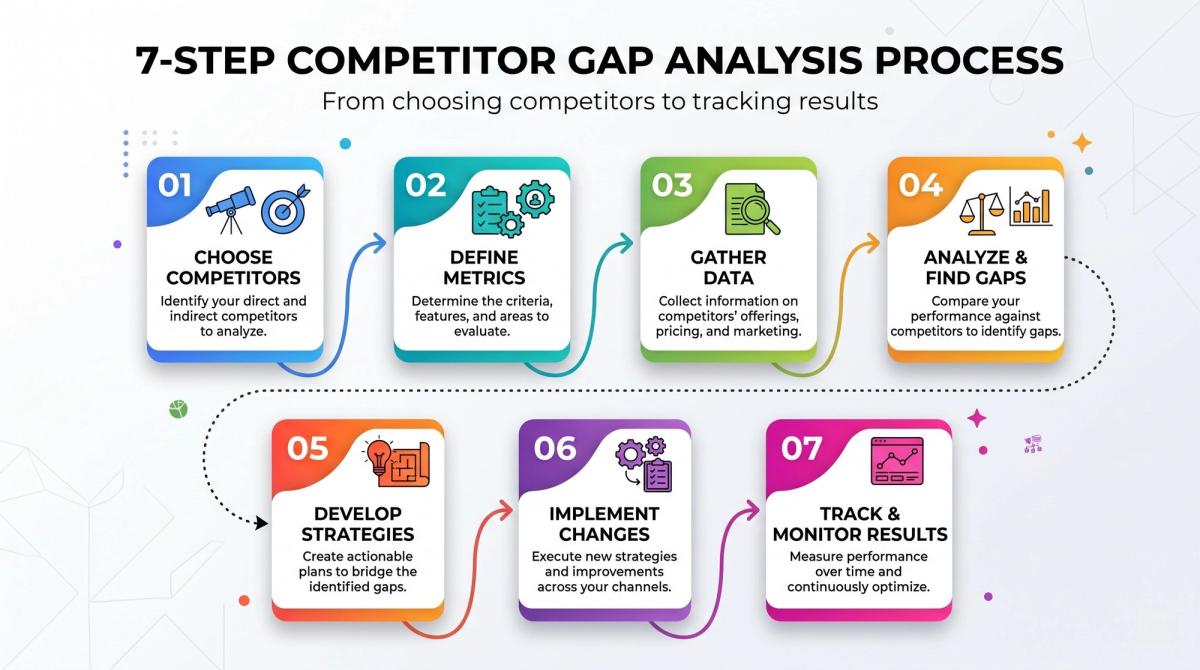
Step-by-Step: How to Run a Competitor Gap Analysis
Here is a simple process any team can follow.
Step 1: Identify Your Real Search Competitors
Your business competitors are not always your search competitors. A software company might compete with review sites, blogs and documentation pages for the same keywords. Search your top 10 keywords and note who appears repeatedly. Choose three to five domains.
Step 2: Run the Keyword Gap Report
Enter your domain and your competitors into your tool of choice. Export the missing and weak keyword lists. Weak keywords are phrases where you rank, but a competitor ranks higher.
Step 3: Filter by Intent and Difficulty
Not every keyword deserves your time. Remove anything irrelevant to your product. Then sort by search volume, keyword difficulty and search intent. Focus on terms where a user is ready to learn, compare or buy.
Step 4: Group Keywords Into Topics
Instead of treating each keyword separately, cluster related terms. This builds topical authority, which means search engines see your site as a trusted source on a subject. One strong page or topic cluster beats five thin pages.
Step 5: Audit the Competitor Content
Open the top-ranking pages. Ask: How long are they? What format do they use? What do they explain well? What do they miss? Your goal is to create something clearer, more useful and better organised.
Step 6: Check the Backlink and Technical Gaps
Run a backlink gap report to find link targets. Then check your own site health: speed, mobile usability, indexing and structured data. Fixing technical gaps often brings quick wins. A dedicated technical SEO service can speed this up if your team is stretched.
Step 7: Build a Priority Roadmap and Track Results
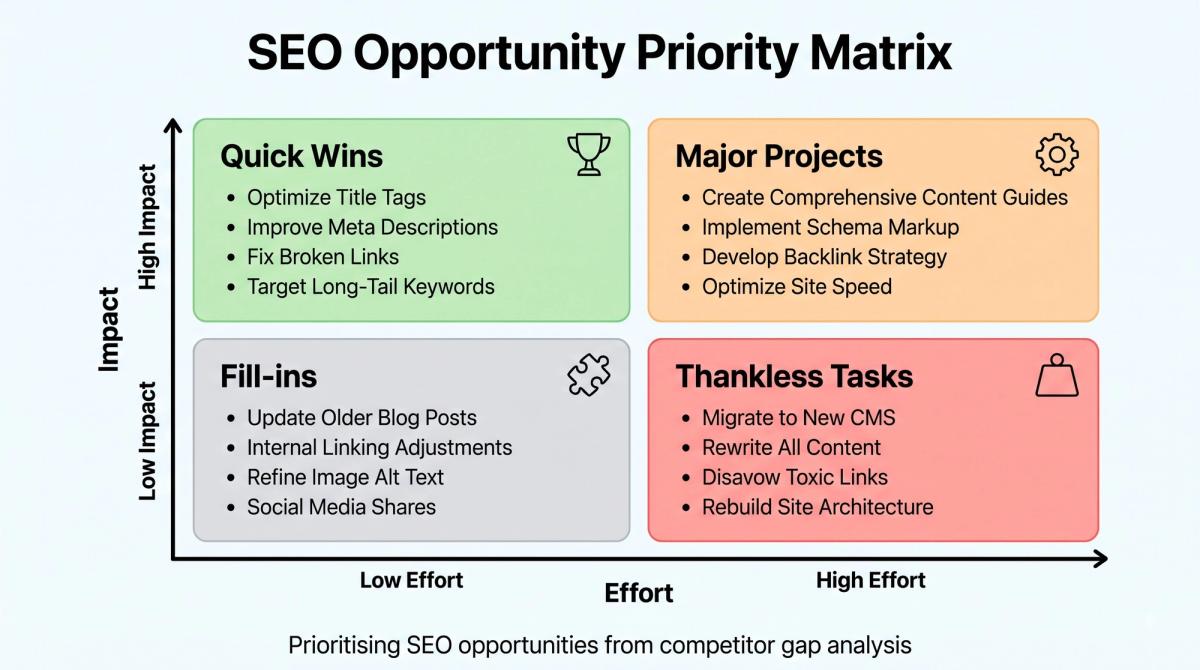
Score every opportunity using impact and effort. Start with high-impact, low-effort items. Track rankings, organic traffic and share of voice monthly, then re-run your gap report each quarter.
Turn Gaps Into Growth: What to Do With the Data
Finding gaps is only half the job. Here is how to act on them.
Create new pages for missing topics, and write them for humans first. Our SEO content writing services approach focuses on clear, helpful content that matches search intent.
Improve existing pages where you rank on page two. Update headings, add examples, refresh data and tighten titles. Careful on-page SEO improvements often move rankings faster than brand-new content.
Earn the missing links. Use your backlink gap list for outreach, guest contributions and digital PR. Quality matters more than quantity, and a steady link building plan builds trust over time.
Support SEO with paid search. For high-value keywords that are hard to rank for, performance marketing can capture demand while your organic pages grow.
Common Mistakes to Avoid
Even experienced teams slip up. Watch out for these.
- Chasing every keyword. A bigger list is not a better list. Focus on relevance.
- Ignoring search intent. A page that does not match what the user wants will not rank, no matter how well optimised.
- Copying competitors. Gap analysis shows opportunity, not a script. Add your own data, examples and expertise.
- Choosing the wrong competitors. Comparing yourself to a giant brand can hide realistic wins.
- Analysing once and stopping. Search results change constantly. Make gap analysis a habit.
- Skipping technical checks. Great content on a slow, poorly crawled site underperforms.
Using AI to Speed Up Gap Analysis
Gap analysis creates a lot of repetitive work: exporting reports, cleaning keyword lists, clustering topics and building monthly dashboards. This is where automation helps.
Teams now use scripts and AI workflows to pull data on a schedule, group keywords by topic, flag new competitor pages and send summaries to Slack or email. Done well, this saves hours every month and lets your experts focus on strategy. If you want to explore this, see how AI workflows and automations can support your SEO reporting.
One caution: AI can cluster and summarise, but a human should always review the final priorities. Tools see data. People understand your business.
Frequently Asked Questions
What are competitor gap analysis tools?
They are software platforms that compare your website with competitors to reveal missing keywords, content topics and backlinks. Popular examples include Semrush, Ahrefs and SE Ranking.
Is there a free competitor gap analysis tool?
Free options exist, but they are limited. Google Search Console, Google Trends and manual search checks can help you start. For full competitor data, you will usually need a paid plan or a trial.
How often should I run a gap analysis?
A full review every quarter works well for most teams. Check key competitors monthly if you work in a fast-moving market.
What is the difference between a keyword gap and a content gap?
A keyword gap is about specific search terms. A content gap is about whole topics or formats you have not covered. They overlap, but content gaps look at the bigger picture.
How many competitors should I analyse?
Three to five is a good range. More than that can make reports noisy and hard to act on.
Can small websites benefit from gap analysis?
Yes. Small sites often gain the most, because they can target low-competition keywords that bigger sites overlook.
Conclusion
Competitor gap analysis tools take the guesswork out of SEO. They show you where rivals are winning, where you are close and where nobody is serving the user well. With the right tool, a clear process and regular reviews, you can turn those gaps into steady organic growth.
Start small. Pick one tool, choose three competitors, run your first keyword gap report and publish one page that fills a real gap. Then repeat.
If you would like expert help turning gap data into rankings, our team at Cinute InfoMedia can guide you. Talk to us for a free digital audit and see what your competitors are doing that you are not yet.
Related Articles

AI Personalization Engines: A Simple Guide for Tech Teams
AI personalization engines use machine learning to show each user the right content, product or offer in real time. This easy guide covers how they work, core models, a 7-step build plan, testing, privacy and SEO for developers, testers, marketers and CTOs.

Instagram Reels Algorithm 2026: A Simple Guide for Tech-Savvy Teams
The Instagram Reels algorithm in 2026 ranks videos by watch time, DM sends and likes per reach. This easy guide explains how Reels are tested, what changed recently, and a practical checklist for developers, marketers, CTOs and product teams.

Business Corporate Intranets: A Simple Guide for Tech Teams
Business corporate intranets give every employee one secure place for news, files, people and tools. This easy guide covers features, architecture, security and a step-by-step build plan for CTOs, developers, testers and marketers.