
Table of Contents
The conversation surrounding artificial intelligence has shifted from conversational outputs to autonomous action. While early enterprise adoption of generative AI focused heavily on content generation, summarization, and interactive chat interfaces, leadership teams are now confronting the structural limitations of static text generation. A prompt-response exchange requires constant human direction to move work forward.
AI agents and the broader discipline of agentic AI represent a significant architectural evolution. Instead of merely predicting the next sequence of words, an AI agent is designed to pursue an operational objective by reasoning through multi-step challenges, using software tools, calling external application programming interfaces (APIs), evaluating intermediate results, and self-correcting along the way.
For technology leaders, product owners, and executive management, moving from conversational copilots to autonomous execution brings substantial business opportunities alongside distinct engineering and operational risks. This guide breaks down what AI agents are, dissects their architectural layers, analyzes their practical enterprise value, details rigorous testing requirements, and maps out a responsible roadmap for enterprise implementation.
What Are AI Agents?
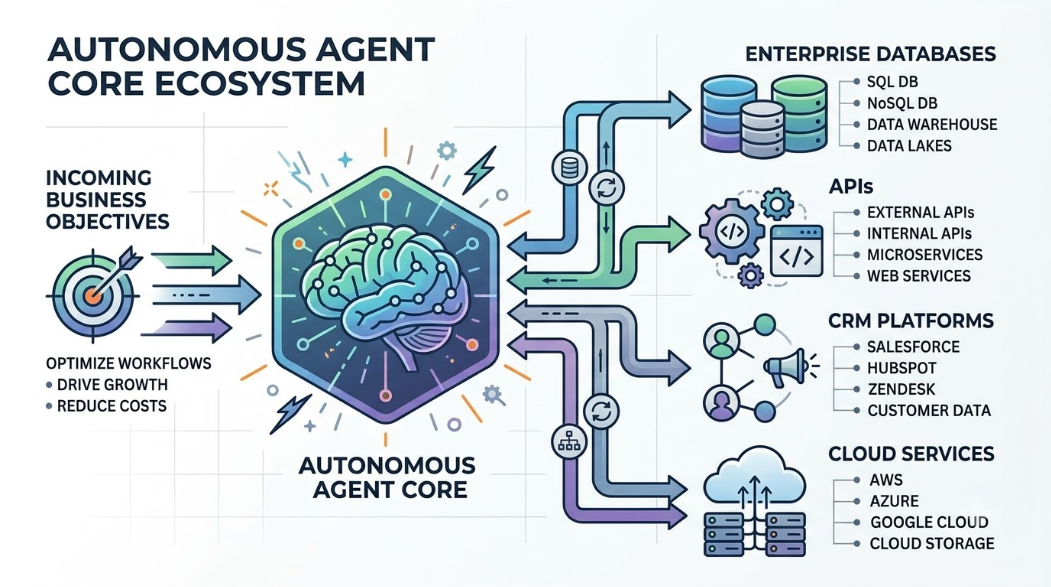
An AI agent is an autonomous or semi-autonomous software entity that perceives its environment, makes contextual decisions using a reasoning model (such as a Large Language Model), and executes multi-step actions using tools and APIs to achieve a defined objective with minimal or structured human intervention.
Unlike deterministic software that executes hardcoded if-then-else logical branches, an AI agent dynamically determines which path to take based on the parameters of the goal it receives.
[Goal / Task Received]
↓
[Perception] (Ingests context, schemas, and system state)
↓
[Reasoning] (Formulates step-by-step operational plan)
↓
[Tool Calling] (Triggers external APIs, queries databases, parses files)
↓
[Evaluation] (Validates output against objective)
↓
[Iterate or Terminate] (Continues to next step, corrects error, or completes)
Autonomous behavior exists along a continuum rather than as an all-or-nothing state. An agent may operate with narrow autonomy such as reading an incoming customer ticket, querying an order database, drafting a contextual refund payload, and stopping for human sign-off or with broader operational latitude, such as orchestrating an end-to-end data pipeline reconciliation across disparate microservices.
How Do AI Agents Work?
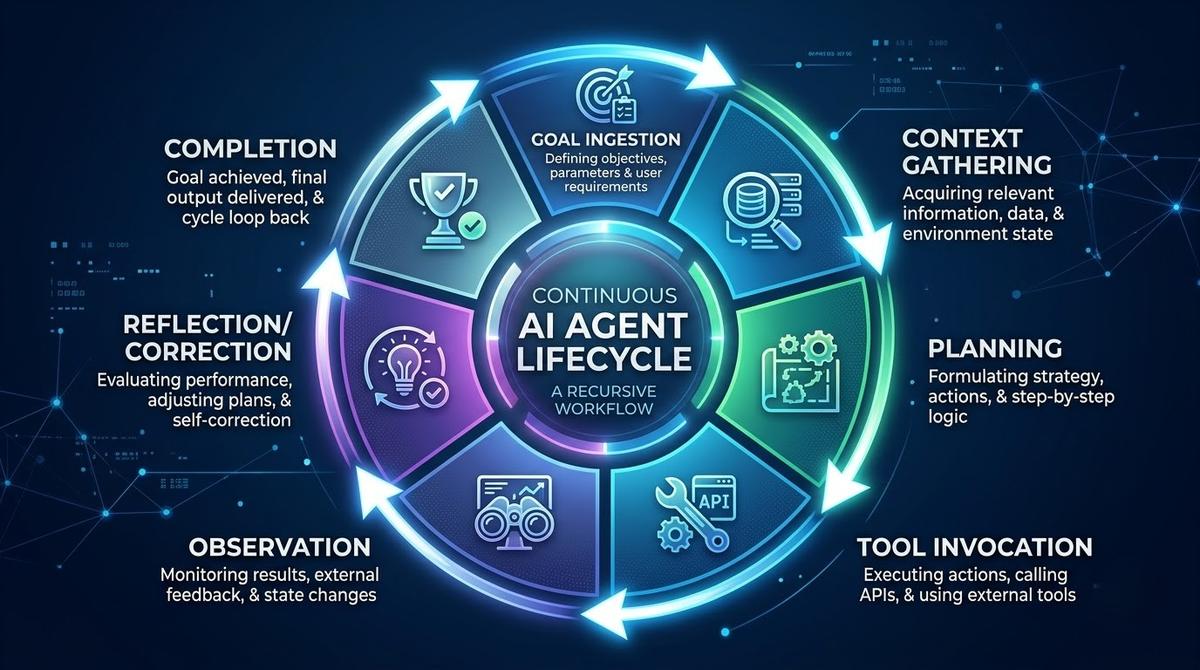
AI agents rely on a continuous cognitive loop. While academic and commercial implementations vary ranging from React (Reasoning + Acting) and Plan-and-Solve patterns to multi-agent orchestrations most enterprise-grade AI agents operate through a repeatable eight-stage lifecycle:
- Goal Ingestion: The agent receives an operational directive (e.g., "Reconcile vendor invoices against procurement records in our ERP and flag discrepancies over $500").
- Context Assembly: The agent gathers ambient data, user constraints, enterprise policies, and state variables from integrated systems.
- Decomposition and Planning: The underlying model breaks the complex goal down into sequential, manageable sub-tasks.
- Reasoning and Evaluation: The agent evaluates its operational boundaries, decides which sub-task to address first, and identifies which external system contains the required information.
- Tool Selection and Execution: The agent formats a structured payload (typically JSON) to invoke a specific tool or API endpoint (e.g., querying a SQL database or executing an HTTP POST request).
- Observation of Output: The agent parses the response received from the tool, checking whether the output matches expected parameters or produced an exception.
- Self-Correction and Reflection: If an error occurs (such as an API timeout or an invalid data schema), the agent re-evaluates its approach, alters its parameters, and tries an alternative path.
- Final Delivery or Human Escalation: Once the objective is met, the agent returns the completed outcome or hands the execution thread to a human operator if it hits a policy threshold.
Key Components of an AI Agent
Building an enterprise AI agent requires more than wrapping a prompt around an API. It requires a resilient system architecture composed of specialized software layers working in harmony:
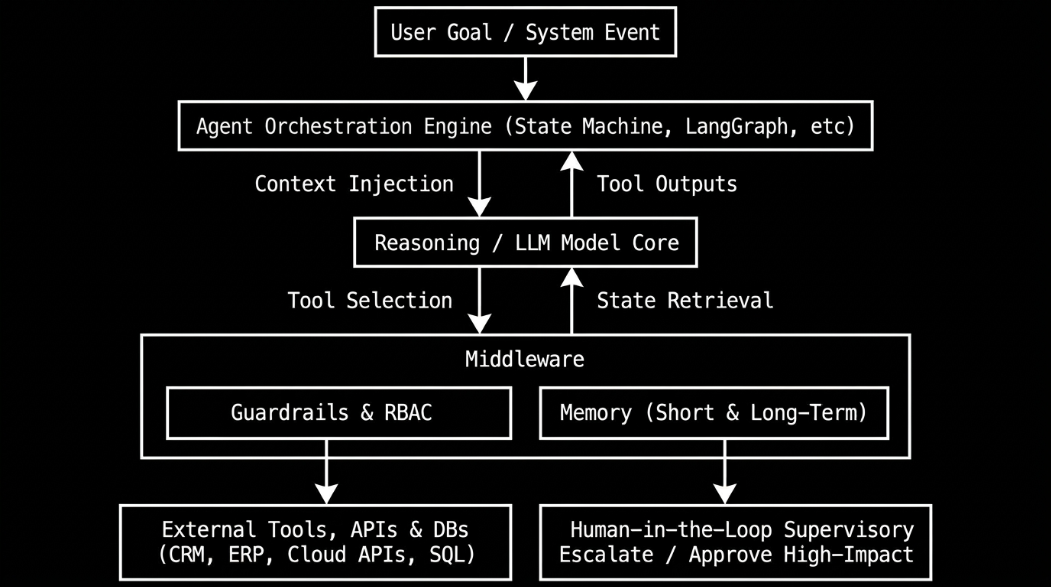
- Foundation Model / Reasoning Core: The central engine (e.g., modern LLMs optimized for function calling and structured reasoning) that processes context, decomposes tasks, and selects actions.
- Instruction Set & System Directives: The deterministic parameters, system prompts, role boundaries, and operational constraints that dictate what the agent is authorized to do.
- Context Engine: The runtime environment that feeds active session data, relevant documents, and real-time state variables to the model.
- Memory Systems:
- Short-Term Memory: Maintains in-context dialogue, immediate task states, and step-by-step tool results during execution.
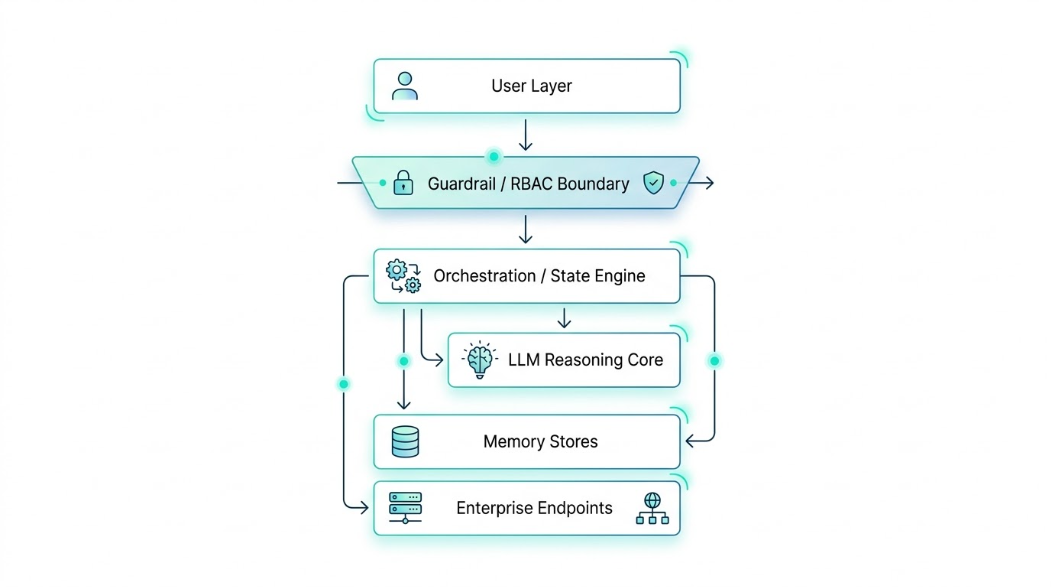
- Long-Term Memory: Persistent vector stores, relational databases, or key-value caches that allow the agent to recall historical transactions, user preferences, and enterprise knowledge across sessions.
- Tool Calling & API Layer: The mechanism by which the model interacts with the outside world. This includes deterministic code interpreters, enterprise database connectors, REST/GraphQL APIs, and web hooks.
- Orchestration Framework: The workflow layer (such as LangGraph, Semantic Kernel, or custom state machines) that controls state transitions, retries, and execution branching.
- Guardrails and Policy Layer: Independent software filters that monitor both inputs and outputs for compliance, security anomalies, prompt injections, and sensitive data leakage before execution occurs.
- Human-in-the-Loop (HITL) Interface: A supervisory channel allowing human reviewers to inspect intermediate agent reasoning, approve high-impact actions, or take over control during edge cases.
AI Agents vs. Chatbots vs. Generative AI
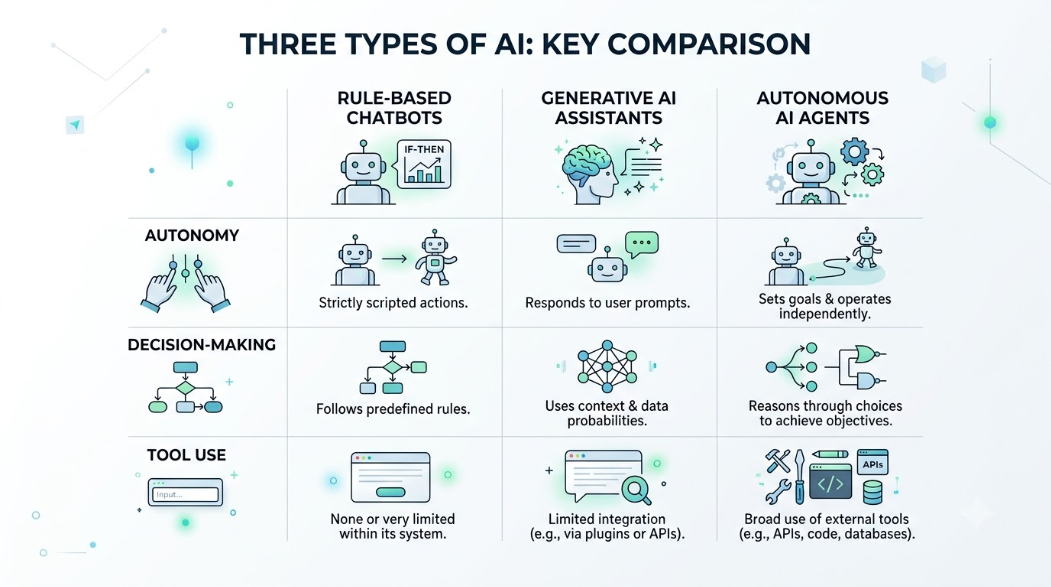
Understanding the operational differences between these technologies prevents organizations from deploying the wrong tool for their operational workflows.
| Feature / Dimension | Traditional Rule-Based Chatbot | Generative AI Assistant | AI Agent | Deterministic Automation (RPA / Scripts) |
|---|---|---|---|---|
| Primary Purpose | Scripted Q&A and basic routing | Text generation, ideation, and summarization | Autonomous execution of multi-step business goals | Repetitive, rule-based process execution across UI/APIs |
| Decision-Making | Fixed decision trees (if/else) | Probabilistic next-token text prediction | Dynamic decomposition, planning, and contextual tool selection | Rigid, deterministic, predefined programmatic logic |
| Tool Usage | Hardcoded webhook calls to pre-selected endpoints | Static retrieval-augmented generation (RAG) | Dynamic runtime selection of APIs, scripts, and databases | Executes scheduled or event-driven pre-programmed scripts |
| Operational Autonomy | Low (fails when inputs deviate from predefined rules) | Low (purely reactive to immediate conversational prompts) | Moderate to High (navigates ambiguous paths to complete tasks) | High execution autonomy, but Zero deviation tolerance |
| Workflow Scope | Single interaction or scripted sequence | Single turn or multi-turn conversational exchange | Complex, multi-system operational pipelines | Linear, high-volume transactional data operations |
| Failure Mode | Returns fallback error ("I didn't understand") | Generates plausible hallucinations or inaccurate text | Can invoke incorrect tools or loop infinitely if unconstrained | Halts execution immediately on unexpected UI/data changes |
What Is Agentic AI?
Agentic AI refers to an architectural design paradigm that imbues artificial intelligence systems with agency the capability to plan, make operational choices, use tools, evaluate outcomes, and act iteratively toward an overarching goal.
Within this domain, systems are categorized into distinct operational paradigms:
- Single-Agent Systems: One autonomous agent handles planning, tool invocation, and execution within a defined business domain.
- Multi-Agent Systems (MAS): Multiple specialized agents collaborate to complete complex workflows. For example, a software maintenance system might employ a Triage Agent to analyze error logs, a Coder Agent to draft an isolated pull request, and a QA Agent to execute functional tests against staging environments.
- Autonomous Workflows: Structured business processes where deterministic logic and agentic decisions alternate, balancing speed, consistency, and contextual adaptability.
Vendors often use these terms interchangeably, but engineering teams must assess the underlying architecture: is the platform simply a chain of static prompts, or is it a dynamic, agentic system capable of contextual self-direction?
Business Use Cases for AI Agents
Organizations deploy AI agents not to replace human personnel, but to remove cognitive friction from complex workflows and execute repetitive multi-step operations.
1. Enterprise Customer Support and Account Operations
Rather than deflecting inquiries with static FAQs, customer support agents inspect order databases, verify warranty entitlements, calculate prorated refunds against company policy, execute payment gateway API calls, and update CRM records all within defined operational thresholds.
2. Software Engineering and Quality Assurance
In modern development workflows, an engineering agent can ingest issue tracker tickets, isolate failure points in repository code, create reproduction scripts, run unit tests, and draft scoped pull requests for human review.
3. IT Helpdesk and System Operations
An IT agent can parse system incident logs, cross-reference active alerts against an internal configuration database, execute diagnostic shell commands in isolated sandboxes, restart unhealthy microservices, and file comprehensive incident post-mortems in internal tracking tools.
4. Back-Office Document Processing & Financial Workflows
Enterprise workflows often require reconciling unstructured data against structured ledgers. AI agents extract line items from complex invoices, validate supplier details against accounting systems, apply procurement rules, and initiate ledger entries for approval. Discover how targeted business process automation allows administrative and operational teams to scale back-office throughput without adding linear headcount.
5. Sales Pipeline and Lead Qualification Operations
Sales agents ingest multi-source engagement signals, cross-reference contact details with company registries, score leads against historical closing profiles, draft bespoke discovery briefs, and update CRM records automatically. Organizations evaluating these touchpoints frequently start by assessing their AI-powered chatbots to see where conversational discovery can be augmented with agentic background workflows.
Benefits of AI Agents for Businesses
- End-to-End Workflow Automation: While traditional tools automate isolated steps, AI agents link multi-step procedures across disparate SaaS platforms, enterprise databases, and proprietary APIs.
- Non-Linear Problem Solving: Agents handle unstructured inputs, such as poorly formatted customer emails or variable document layouts, without breaking predefined operational chains.
- Continuous Operational Availability: Enterprise back-office operations, triage queues, and data monitoring processes run continuously across global operational hours.
- Scalable Business Throughput: Companies handle volume spikes in processing transactions, leads, or support tickets without incurring linear increases in staffing overhead.
- Accelerated Data Consolidation: Agents instantly query fragmented enterprise repositories, synthesize disparate operational data, and present unified summaries to executive decision-makers.
Risks and Limitations of AI Agents
Deploying systems with tool-calling capabilities introduces security and operational failure modes that do not exist in conventional software or basic generative text models:
- Hallucinated Actions and Erroneous Logic: An agent may accurately formulate an operational plan yet select the wrong tool or submit malformed data payloads, corrupting downstream records.
- Prompt Injection and Indirect Injection Attacks: Malicious actors can embed instructions inside external data sources (such as an email or website form) that override the agent's core instructions, forcing it to exfiltrate database contents or execute unintended system actions.
- Excessive Autonomy and Inadequate Permissions: Granting an agent broad write access to production databases or administrative APIs without granular role-based access control (RBAC) creates systemic operational exposure.
- Compounding Errors in Multi-Step Chains: In an eight-step execution chain, an uncorrected error at step two can cascade, causing subsequent decisions to drift dramatically from the initial business objective.
- Latency and Cost Volatility: Complex agentic reasoning loops make multiple foundation model calls per task. This can introduce latency (often 10–45 seconds per run) and rapidly accumulate token costs if monitoring is absent.
- Infinite Execution Loops: In edge-case failure states, an agent may repeatedly attempt alternative paths to solve an unresolvable problem, consuming resources without terminating.
AI Agent Architecture
An enterprise-ready AI agent architecture isolates the cognitive layer from direct system access through explicit control and monitoring boundaries:
How Should AI Agents Be Tested?
Testing an agentic system requires a departure from traditional deterministic QA methodologies. Because underlying foundation models are non-deterministic, systems can generate variable reasoning traces to reach identical endpoints.
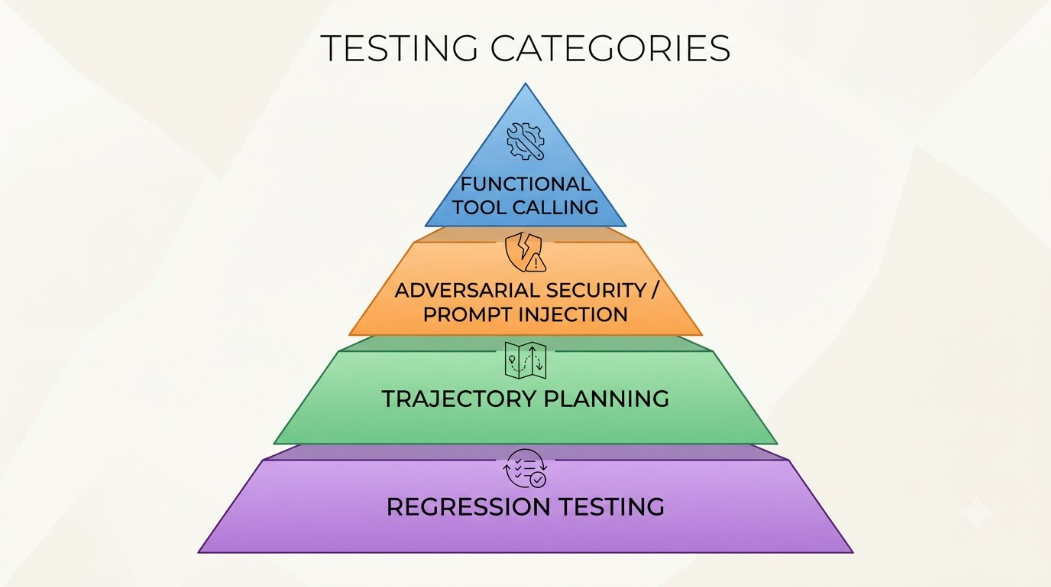
Comprehensive agent testing must encompass multiple engineering dimensions:
- Functional Tool-Calling Accuracy: Verifying that the model translates unstructured context into correct, schema-compliant JSON payloads for API consumption without omitting mandatory arguments.
- Adversarial and Security Testing: Subjecting agents to direct and indirect prompt injection attempts to confirm that system guardrails block unauthorized tool execution or sensitive data exfiltration.
- Hallucination and Boundary Testing: Evaluating agent responses when confronted with missing data or impossible tasks. The agent must cleanly terminate or escalate rather than fabricate actions.
- Trajectory and Plan Evaluation: Measuring whether the agent selects the most efficient, safe path of sub-tasks, rather than taking unnecessary or expensive exploratory steps.
- State Drift and Regression Testing: Running deterministic benchmark datasets (golden evaluation sets) against new model versions to verify that reasoning accuracy does not degrade over time.
- System Failure Recovery Testing: Simulating external API errors, database timeouts, and rate limits to verify that the agent gracefully retries, switches strategies, or surfaces a descriptive escalation.
- Deterministic Guardrail Auditing: Testing the code-based boundary layer to ensure that regardless of what the LLM decides, unauthorized actions (e.g., executing a balance transfer over policy limits) are intercepted and rejected programmatically.
Maintaining rigorous testing standards across modern digital systems is essential. Whether executing standard continuous integration or building specialized evaluation pipelines, teams must rely on thorough QA & testing frameworks to maintain software resilience before releasing tools into production environments.
How to Implement AI Agents in an Enterprise
Adopting agentic systems requires a phased, risk-managed implementation roadmap:
[Phase 1: Discovery] → Identify narrow, high-frequency, multi-step bottlenecks
↓
[Phase 2: Data & APIs] → Build clean REST/GraphQL endpoints with granular RBAC
↓
[Phase 3: Model & Prompt] → Select reasoning models optimized for tool calling
↓
[Phase 4: Guardrails] → Implement deterministic validation and HITL escalation ↓
[Phase 5: Pilot & Scale] → Deploy in an internal shadow sandbox, monitor, and iterate
- Identify High-Value, Scoped Problems: Avoid selecting open-ended, ambiguous challenges. Focus on repetitive, structured business processes with clear inputs, established rules, and verifiable success criteria.
- Expose Granular, Well-Documented APIs: Agents cannot navigate convoluted legacy systems directly. Build structured endpoints that provide clear documentation and strict data typing.
- Establish Model and Tool Selection: Choose models known for high function-calling accuracy. Match tools to business tasks, ensuring each API accepts specific, validated schemas.
- Implement Programmatic RBAC and Guardrails: Restrict write permissions. Build deterministic filters that validate tool payloads before they hit downstream infrastructure.
- Incorporate Human Oversight Triggers: Define explicit operational limits. If an action exceeds a financial value, involves sensitive client data, or yields low model confidence, route it to an employee.
- Run Shadow-Mode Pilots: Deploy the agent in a live environment where its tool calls are simulated or logged for review rather than executed directly against production records.
- Monitor, Measure, and Scale: Track end-to-end task completion rates, cost per execution, latency, tool invocation failures, and user escalation rates before expanding access.
How AI Agents Integrate With Existing Business Systems
AI agents do not replace legacy infrastructure; they sit as an intelligent orchestration layer on top of it. Integration relies on established integration patterns:
- Enterprise SaaS Platforms: Modern CRM and ERP platforms (such as Salesforce, HubSpot, and SAP) expose REST APIs and webhooks that agents consume to inspect accounts, update pipelines, and trigger workflows.
- Relational and Vector Databases: Agents query relational databases (PostgreSQL, MySQL) via secure microservices to verify real-time state, while referencing vector databases to retrieve unstructured enterprise documentation.
- Event-Driven Messaging Busses: Systems can deploy agents as consumers on message queues (e.g., Apache Kafka or RabbitMQ), allowing them to react asynchronously to business events.
- Headless and Decoupled Architecture: Modern applications built on decoupled frameworks allow agents to manipulate content and operational workflows programmatically. Teams building headless ecosystems often structure their content layers using modern headless CMS platforms so that both internal software and AI workflows can access structured content via standard APIs.
Exploring how to integrate modern AI workflows into your company's digital architecture? Schedule a technical consultation to discuss integration feasibility, API design, and system architecture.
When Should a Company Use AI Agents?
Not every business problem requires an autonomous agent. In many situations, simpler engineering solutions provide superior reliability and lower operating costs.
Ideal Scenarios for AI Agents:
- Dynamic, Multi-Step Problem Solving: Workflows where the precise sequence of steps depends on unstructured input data (e.g., triaging complex customer disputes).
- Cross-Silo Enterprise Coordination: Workflows that require reading, translating, and updating data across multiple disparate SaaS platforms lacking direct native integrations.
- Variable Language-to-Data Transformations: Processes that require translating ambiguous human instructions into formal SQL queries, API payloads, or system filters.
Unsuitable Scenarios for AI Agents:
- High-Risk Operations Without Human Oversight: Financial transactions, safety-critical systems, or medical diagnostic actions where non-deterministic errors carry unacceptable legal or life-safety consequences.
- Strictly Deterministic Processes: If a business workflow follows a rigid path without variation (e.g., standard payroll calculations), hardcoded scripts or standard automation tools are faster, less expensive, and mathematically predictable.
- Environments with Poor Data Hygiene: If an organization's databases and internal APIs lack documentation, authentication standards, or schema consistency, an agentic reasoning engine will fail predictably.
AI Agents and the Future of Business Automation
The trajectory of business automation points away from standalone software applications toward collaborative, multi-agent enterprise networks.
As reasoning models become more capable and cost-effective, organizations will transition from deploying ad-hoc tools to maintaining federated agent ecosystems. In these environments, specialized domain agents handling marketing analysis, software operations, inventory forecasting, and financial reconciliation will coordinate through secure API protocols, updating human managers asynchronously.
Furthermore, multi-modal advancements will allow agents to inspect application user interfaces directly, parse visual architectural diagrams, and generate contextual responses across diverse formats.
Crucially, successful adoption will not depend solely on model breakthroughs. The determining factors for enterprise success will be system architecture, permission boundaries, rigorous evaluation pipelines, and transparent human oversight.
How Cinute Infomedia Can Support Digital and AI-Driven Initiatives
Executing scalable digital transformation requires sound architectural foundations, resilient engineering, and thorough quality processes. Organizations looking to adopt intelligent automation often face integration challenges across their web platforms, internal workflows, and third-party APIs.
Cinute Infomedia can be considered as a technology partner for organizations exploring AI-driven digital solutions, subject to specific project requirements. Backed by experienced engineering leadership and multi-disciplinary teams across nine practice areas, the company delivers full-stack services across custom web development and digital services.
For businesses looking to prepare their technical infrastructure for modern automation, Cinute Infomedia provides practical technical expertise across several core areas:
- API and Custom Web Engineering: Designing the secure, modern web architectures, headless CMS systems, and RESTful APIs necessary for automated workflows to communicate cleanly with core applications.
- Workflow and Chatbot Implementations: Deploying intelligent conversational chatbots, lead enrichment systems, and automated business process workflows designed to streamline operations.
- Quality Assurance and System Testing: Applying rigorous software testing methodologies to ensure that digital touchpoints, web applications, and integrated pipelines operate reliably under production conditions.
Organizations evaluating their technical roadmaps can review Cinute Infomedia's background on their about page or meet the senior engineering and delivery leaders on our team to assess project alignment.
Frequently Asked Questions
1. What is an AI agent in simple terms?
An AI agent is a software program that uses a reasoning model (such as a Large Language Model) to pursue an assigned goal. It breaks the goal into steps, uses external digital tools and APIs to take real actions, inspects the results, and adjusts its approach until the goal is accomplished or human assistance is requested.
2. How is an AI agent fundamentally different from a chatbot?
A traditional chatbot responds to conversational inputs using hardcoded rules or basic text generation, relying entirely on continuous human prompts. An AI agent is goal-oriented; it has the autonomy to plan multi-step workflows, call third-party APIs, query databases, execute code, and verify intermediate outcomes without requiring step-by-step user commands.
3. Are AI agents fully autonomous?
No. In enterprise applications, autonomy is carefully scoped and bounded. Systems typically operate under constrained delegation with defined permissions, strict role-based access controls, and programmatic guardrails. High-impact operational thresholds (such as significant financial transactions or policy changes) are routed to human operators via Human-in-the-Loop design patterns.
4. How do AI agents use external APIs and software tools?
Agents utilize model capabilities known as function calling or tool calling. When an agent determines that an action requires external data or execution, the underlying model generates a structured JSON object specifying the target API endpoint and required arguments. The host application executes the request against the external service and returns the output payload to the agent to inform its next step.
5. What are the biggest risks of using AI agents in business?
The primary risks include hallucinated decisions, indirect prompt injection (where malicious text in ingested documents overrides agent rules), cascading errors across multi-step chains, unintentional data leaks, and unexpected cloud computing costs caused by unconstrained execution loops.
6. Can AI agents completely replace enterprise software or employees?
No. AI agents act as an intelligent orchestration layer that augments human productivity and connects existing software systems. They excel at automating repetitive, multi-step cognitive tasks, freeing employees to focus on strategic, creative, and supervisory activities that demand nuanced human judgment.
7. How should engineering teams test non-deterministic AI agents?
Teams must implement multi-layered evaluation frameworks. This includes using deterministic test suites (golden datasets) to assess trajectory planning, validating tool-calling schema compliance, conducting adversarial security testing against prompt injections, evaluating boundary fallback behaviors, and auditing programmatic guardrails.
Conclusion
AI agents mark an important transition in enterprise technology: moving beyond passive text generation toward goal-driven operational execution. By unifying foundation models with external tools, contextual memory, and programmatic APIs, agents offer organizations a mechanism to automate multi-step digital workflows that previously required continuous manual intervention.
However, realizing measurable business value requires looking past early market hype. Organizations must navigate genuine engineering challenges, including non-deterministic outputs, complex API security, latency, and operational risk.
Achieving long-term ROI demands an architecturally sound approach: selecting well-scoped business use cases, enforcing strict role-based permissions, maintaining human-in-the-loop oversight, and applying rigorous testing protocols. When deployed responsibly with a capable technology partner, AI agents provide a powerful foundation for scalable, resilient enterprise automation.
Related Articles
SEO Monitoring Tools: Technical Implementation Guide for Developers
Comprehensive technical guide to SEO monitoring tools designed for software developers and product managers. Learn how to integrate monitoring into development workflows, track technical SEO metrics, and automate performance reporting with modern tools and APIs.
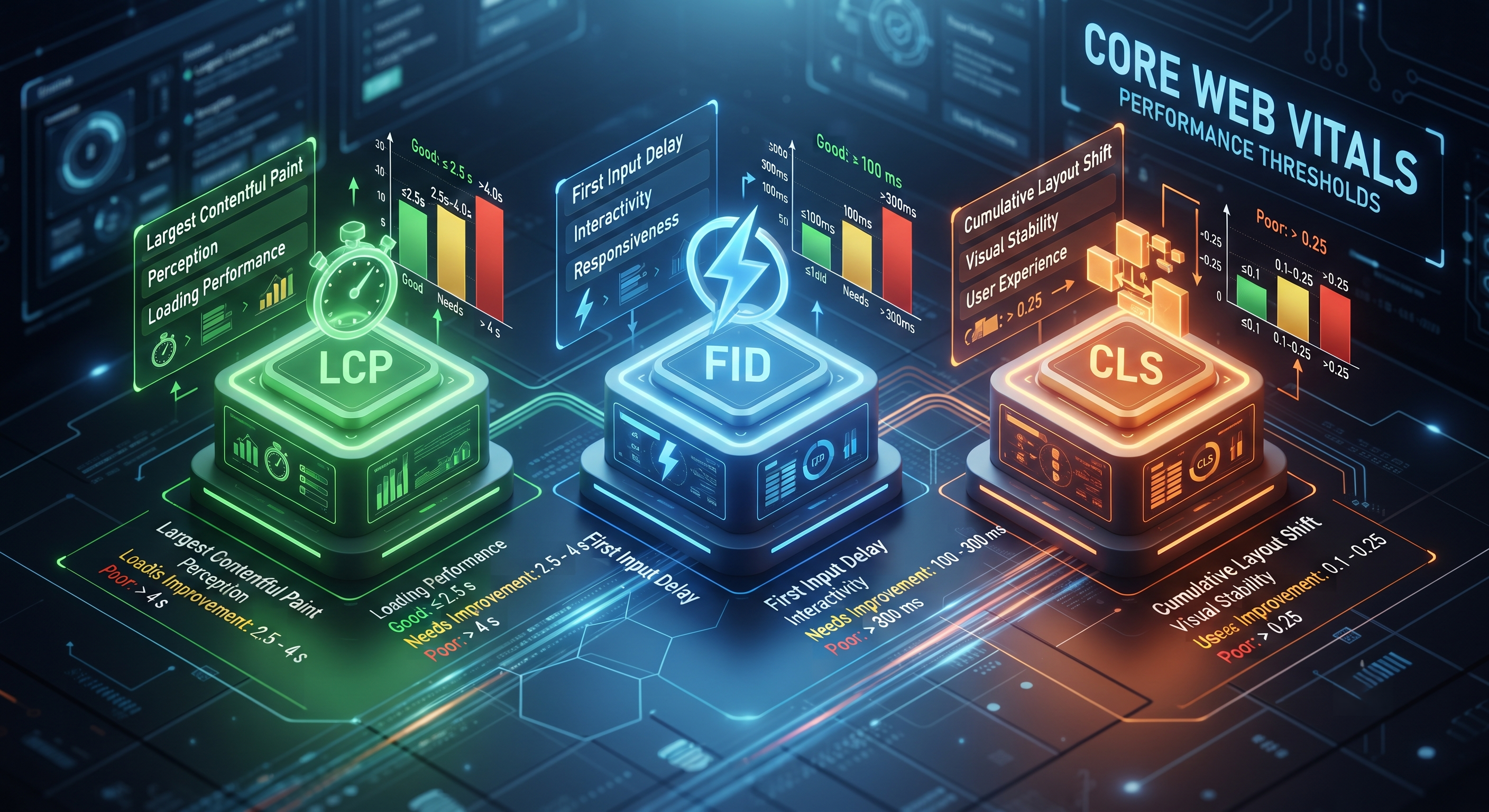
Core Web Vitals Fixes Guide: Complete Technical Implementation for Developers
Master Core Web Vitals optimization with our technical implementation guide. Learn LCP, FID, CLS fixes with code examples and strategies tailored for developers and CTOs.
The Ultimate Guide to Performance Marketing in 2026 (Strategy, KPIs & ROI)
Discover how performance marketing drives measurable ROI and learn why high-speed web development and AI automation are the secret weapons to maximizing your return on ad spend in 2026.