
Table of Contents
As a developer or tech professional, you understand that website visibility directly impacts business revenue. Search Engine Optimization isn't just marketing it's a technical discipline that directly affects your infrastructure, performance metrics, and bottom line.
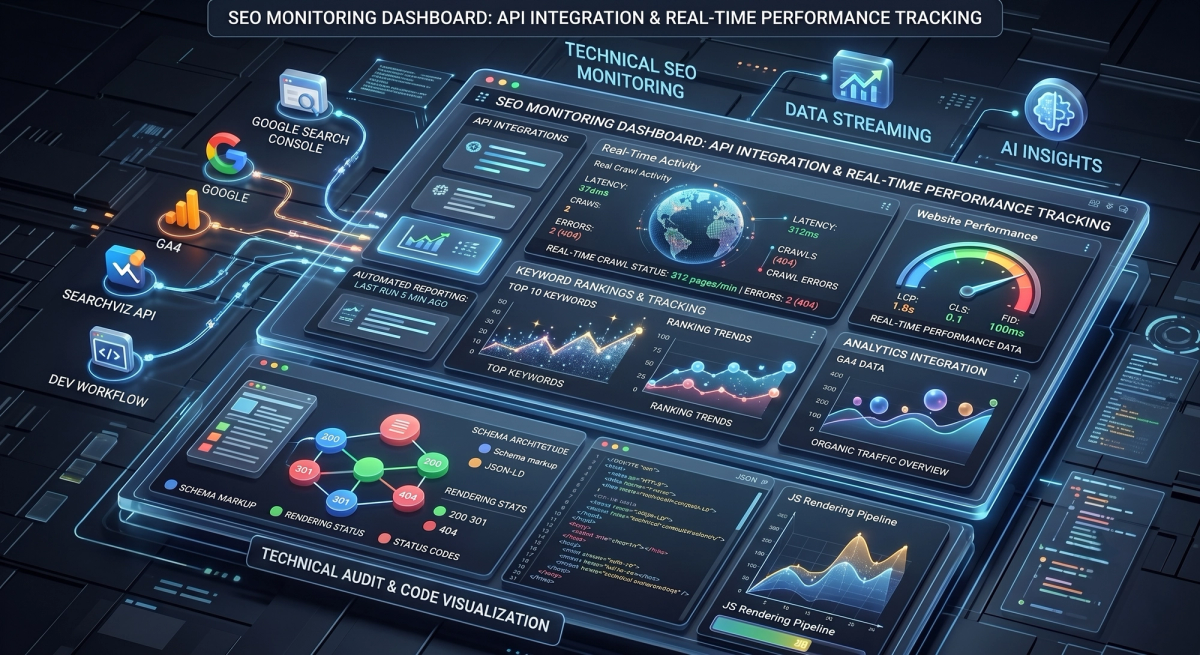
But here's the challenge: managing SEO metrics across multiple platforms, integrating data from various sources, and maintaining visibility into ranking performance requires sophisticated monitoring tools. Unlike generic marketing dashboards, modern SEO monitoring solutions offer API integrations, real-time data streams, and developer-friendly interfaces.
This guide walks you through the technical implementation of SEO monitoring tools, showing you how to integrate them into your development workflow, automate reporting, and leverage data-driven insights for continuous optimization. Whether you're managing a SaaS platform, enterprise website, or custom web application, these monitoring tools and techniques are essential for maintaining organic visibility.
At Cinute InfoMedia, we've implemented SEO monitoring across 300+ web development projects. We'll share what we've learned about integrating these tools into technical stacks, automating performance tracking, and building data pipelines that feed directly into your CI/CD workflows.
Understanding SEO Monitoring in Technical Context
SEO monitoring isn't just about checking where your website ranks. It's about:
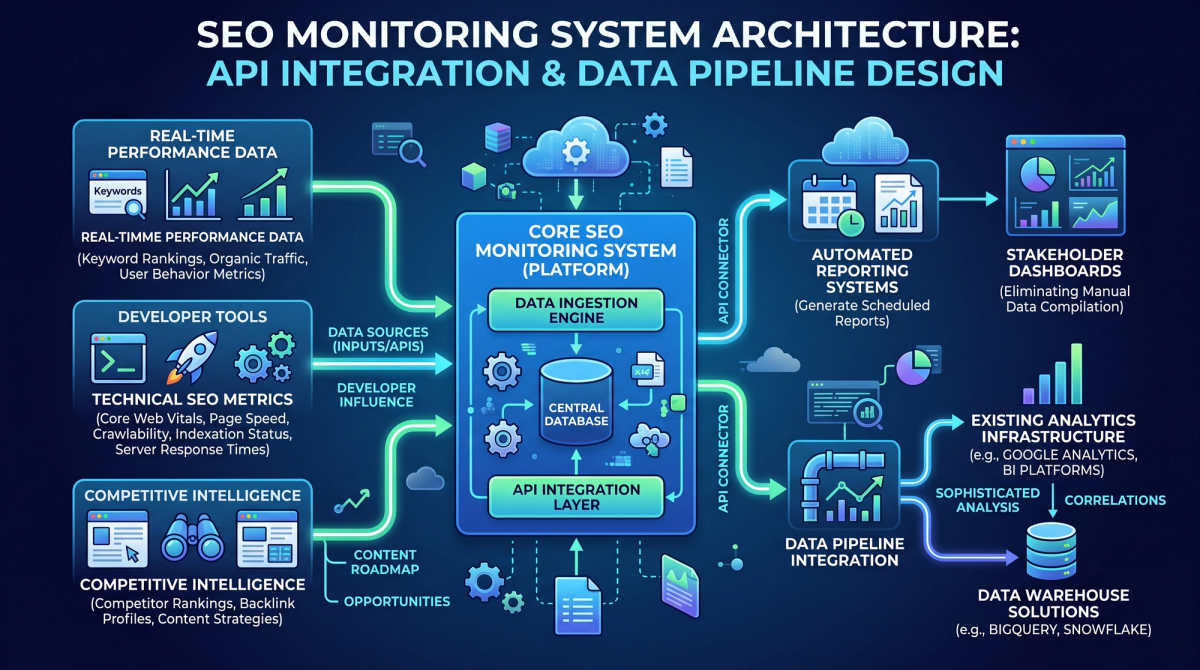
Real-time Performance Tracking: Continuously monitoring keyword rankings, organic traffic, and user behavior metrics. This data feeds into your analytics systems, allowing you to make data-driven decisions about content, technical optimization, and user experience improvements.
Technical Metrics Integration: Tracking Core Web Vitals, page speed, crawlability, indexation status, and server response times. These metrics directly impact both user experience and search engine rankings areas where developers have direct influence.
Competitive Intelligence: Monitoring competitor rankings, backlink profiles, and content strategies. This competitive data informs your content roadmap and helps identify opportunities in underserved keyword territories.
Automated Reporting: Generating scheduled reports that automatically feed into stakeholder dashboards, eliminating manual data compilation and ensuring stakeholders always have current information.
Data Pipeline Integration: Connecting SEO data with your existing analytics infrastructure (Google Analytics, Data Warehouse solutions, BI platforms) to enable sophisticated analysis and correlation studies.
For technical SEO optimization projects, this monitoring infrastructure is fundamental. You can't optimize what you don't measure.
Top SEO Monitoring Platforms for Technical Teams
1.Google Search Console API
Why It Matters:
GSC is your official source for Google's perspective on your website. The GSC API provides programmatic access to search performance data, indexation status, and coverage issues.
Technical Integration:
- OAuth 2.0 authentication
- REST API endpoints for query performance, sitemaps, and URL inspection
- Webhook support for real-time notifications about indexation issues
- Python, Node.js, and Java client libraries available
Key Metrics: Impressions, clicks, CTR, average position, queries, pages, devices, countries
Developer-Friendly: Excellent. GSC API integrates directly into CI/CD pipelines for automated monitoring.
Best For: Foundational tracking, understanding Google's crawl perspective, identifying indexation issues
2.Ahrefs API
Why It Matters:
Ahrefs maintains the largest backlink database and provides comprehensive competitive analysis. For developers managing enterprise SEO, Ahrefs' API enables automated rank tracking, backlink monitoring, and competitive benchmarking.
Technical Integration:
- REST API with structured JSON responses
- Webhook support for rank tracking alerts
- Rate limiting: 10 API credits per second
- SDKs available for major programming languages
Key Metrics: Domain Authority, backlinks, referring domains, ranking keywords, organic traffic estimates, technical health scores
Developer-Friendly: Very good. Clean API documentation and granular access control.
Best For: Competitive analysis, rank tracking at scale, backlink monitoring, technical SEO audits
3.SEMrush API
Why It Matters:
SEMrush provides integrated data on organic and paid search, social media, and content marketing. For product teams managing multi-channel campaigns, SEMrush API integration enables comprehensive digital marketing visibility.
Technical Integration:
- REST API with batch processing support
- WebSocket connections for real-time data streaming
- Advanced filtering and segmentation options
- API keys with granular permission control
Key Metrics: Organic keywords, paid keywords, traffic analytics, backlinks, content gap analysis, domain overview
Developer-Friendly: Excellent. Comprehensive API documentation with code examples in multiple languages.
Best For: Multi-channel marketing analysis, position tracking, content strategy optimization, competitive landscape monitoring
4.Data Studio & BigQuery Integration
Why It Matters:
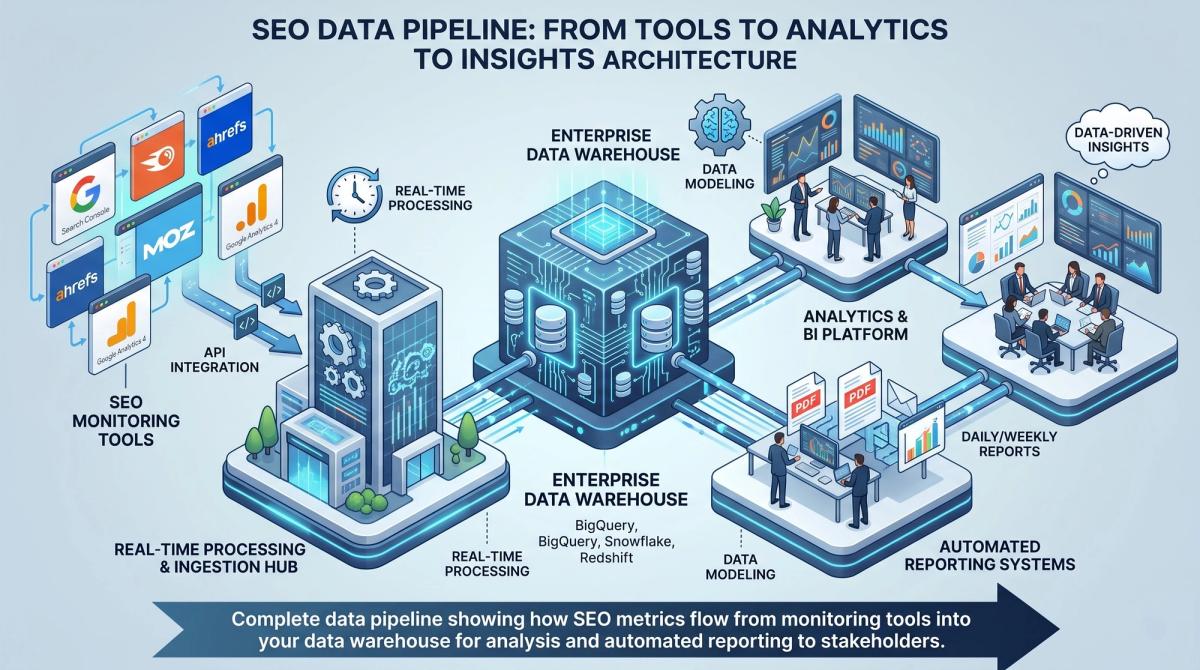
Modern monitoring isn't just about individual tools it's about integrating data from multiple sources into a unified analytics platform. Google Data Studio and BigQuery enable this through connectors to GSC, Google Analytics, and custom APIs.
Technical Implementation:
- Create BigQuery datasets from GSC API data
- Schedule daily data imports using Cloud Functions or Dataflow
- Build Data Studio dashboards that refresh automatically
- Combine SEO data with other metrics (conversion rate, revenue, user behavior)
Developer-Friendly: Excellent. Extensive Google Cloud documentation and community resources.
Best For: Enterprise reporting, data warehouse integration, correlating SEO data with business metrics
Implementing SEO Monitoring in Development Workflows
API-First Approach
Instead of manually checking rankings in tool dashboards, build automated systems that continuously monitor performance:
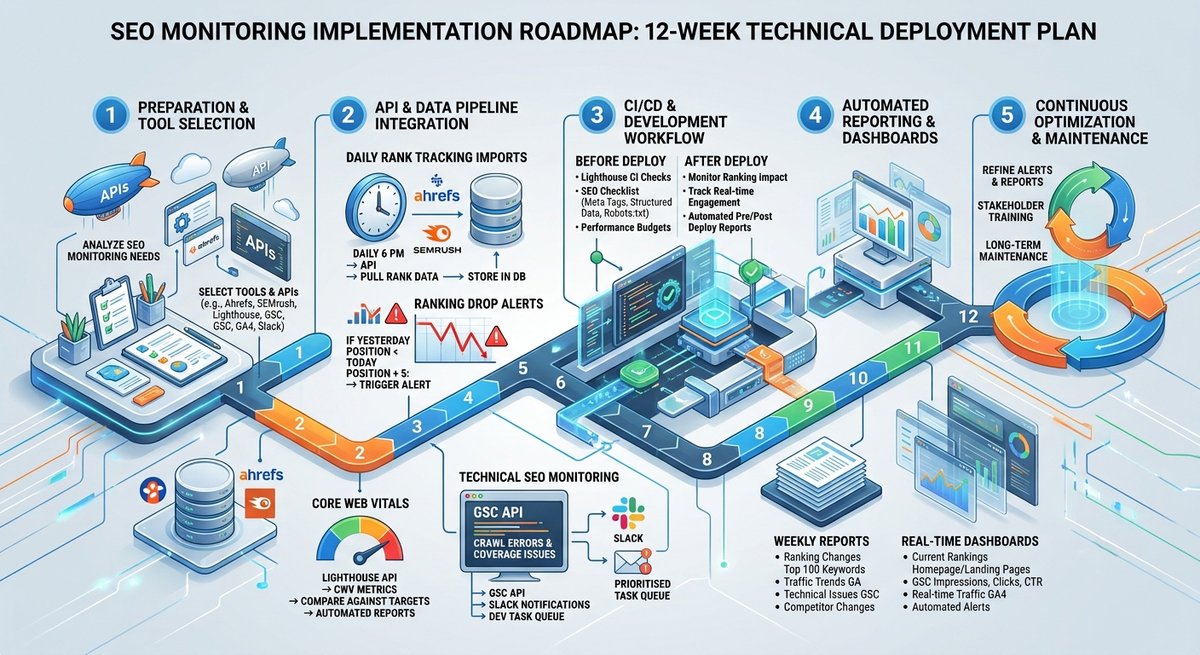
1. Set up daily rank tracking imports:
Daily 6 PM → Ahrefs/SEMrush API → Pull rank data for tracked keywords → Store in database → Data pipeline2. Create alerts for ranking drops:
If yesterday_position < today_position + 5: → Trigger alert → Investigate potential issues3. Monitor Core Web Vitals integration:
Lighthouse API → Performance metrics → Compare against targets → Automated report generation4. Technical SEO monitoring:
Google Search Console API → Crawl errors/coverage issues → Real-time Slack notifications → Prioritized dev task queueIntegration with CI/CD Pipelines
Modern development teams integrate SEO checks into deployment workflows:
Before Deploy:
- Lighthouse CI checks Core Web Vitals against thresholds
- SEO checklist validation (meta tags, structured data, robots.txt)
- Performance budgets enforcement
After Deploy:
- Monitor ranking impact of changes
- Track real-time engagement metrics
- Create automated performance reports comparing pre/post-deploy
Automated Reporting Systems
Rather than manual report generation, build systems that automatically create stakeholder-ready dashboards:
Weekly Reports:
- Ranking changes for top 100 keywords
- Traffic trends from Google Analytics
- Technical issues from GSC
- Competitor ranking changes
Real-time Dashboards:
- Current rankings for homepage and key landing pages
- GSC data: impressions, clicks, CTR
- Real-time traffic from GA4
- Automated alerts for significant changes
For comprehensive SEO services, this level of automation ensures continuous optimization without manual intervention.
Critical Metrics for Technical SEO Monitoring
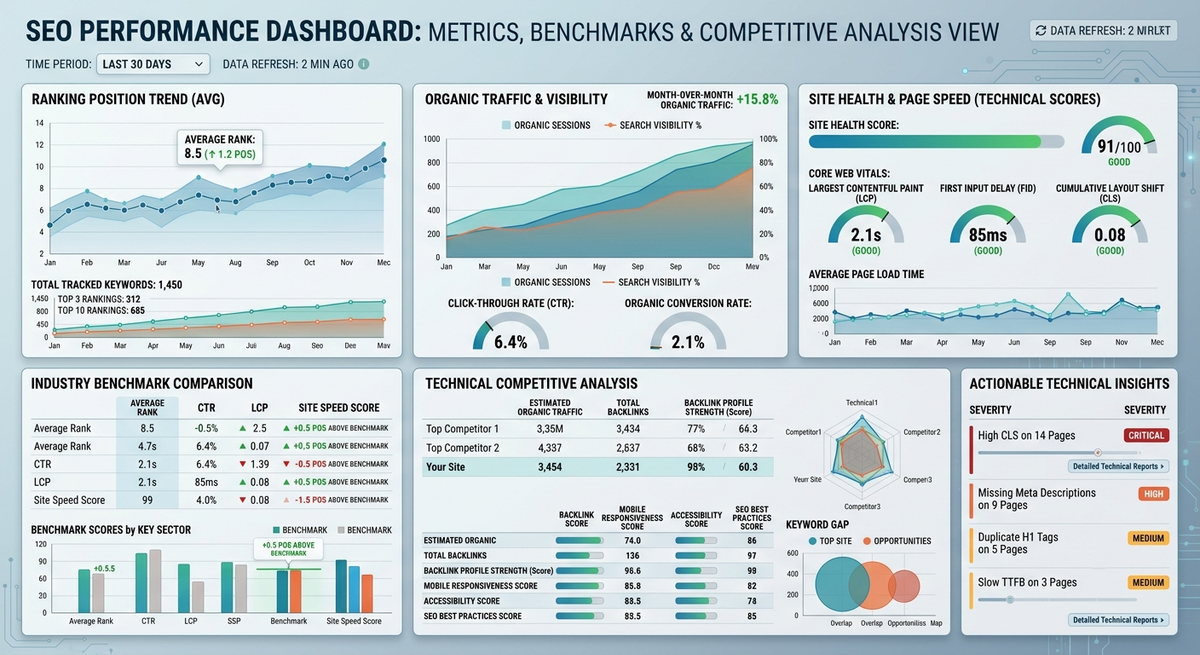
A. Ranking & Visibility Metrics
Organic Visibility Score: Overall representation in search results across tracked keywords. Tools like SEMrush and Ahrefs calculate this by combining rank position, search volume, and competition level.
Top Keywords by Traffic Value: Not all rankings are equal. Identify which keyword rankings drive the most organic traffic (based on search volume and CTR).
Rank Distribution Analysis: How many keywords rank in positions 1-3, 4-10, 11-20, etc. This reveals improvement opportunities moving keywords from position 11 to position 5 drives disproportionate traffic increases.
B.Technical Performance Metrics
Core Web Vitals:
- Largest Contentful Paint (LCP) ≤ 2.5 seconds
- First Input Delay (FID) ≤ 100 milliseconds
- Cumulative Layout Shift (CLS) ≤ 0.1
Page Speed Metrics:
- First Contentful Paint (FCP)
- Time to First Byte (TTFB)
- Server Response Time
Crawl Efficiency:
- Crawl budget utilization (% of available crawl budget used)
- Crawl depth (how deep Googlebot crawls your site)
- Redirect chains (which reduce crawl efficiency)
C.Content & Indexation Metrics
Pages Indexed: Total pages Google has indexed from your site. Use GSC API to monitor this daily significant drops indicate potential technical issues.
Indexation Rate: (Indexed pages / Total pages) × 100. Target >80% for well-structured sites.
Coverage Issues: Monitor these from GSC API:
- Excluded pages (blocked by robots.txt, noindex, canonical issues)
- Errors (404s, server errors, crawl issues)
- Valid with warnings (duplicate pages, no title tags, slow pages)
D. Competitive Intelligence Metrics
Share of Voice (SOV): What % of impressions do you capture for your target keywords? If competitors have higher SOV, investigate their content strategy and link profile.
Keyword Gap Analysis: Keywords competitors rank for but you don't. These represent opportunities.
Backlink Profile Comparison: Compare your backlinks against top 3 competitors to identify link-building opportunities.
Advanced Monitoring: Building Custom Solutions
When Off-the-Shelf Tools Aren't Enough
For large-scale operations, consider building custom monitoring systems:
Scenario 1: Multi-Site Enterprise If you manage 50+ domains, custom monitoring aggregates data across all properties, providing unified visibility and enabling cross-domain analysis.
Scenario 2: Custom Metrics Maybe you need to track specific business metrics (revenue per keyword, customer acquisition cost per traffic source, lifetime value by channel). Build pipelines that combine SEO data with your CRM and business intelligence systems.
Scenario 3: Real-Time Alerting Off-the-shelf tools provide daily or weekly reports. For critical changes, custom webhooks and alert systems provide immediate notification of significant ranking drops or technical issues.
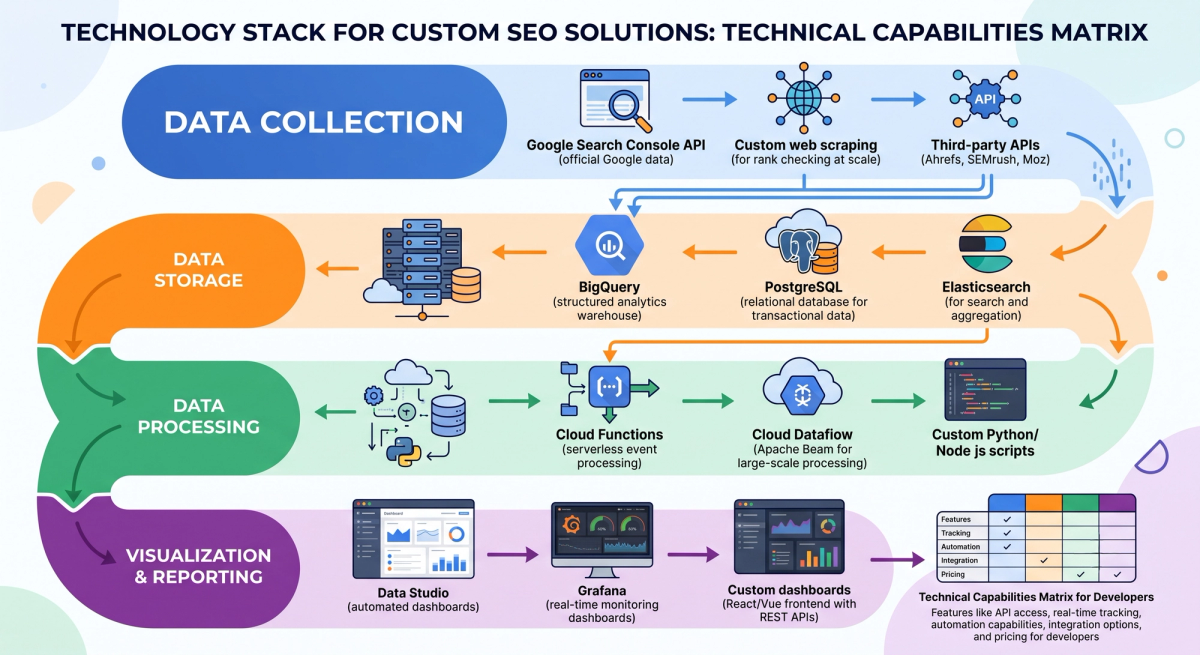
Technology Stack for Custom Solutions
Data Collection:
- Google Search Console API (official Google data)
- Custom web scraping (for rank checking at scale)
- Third-party APIs (Ahrefs, SEMrush, Moz)
Data Storage:
- BigQuery (structured analytics warehouse)
- PostgreSQL (relational database for transactional data)
- Elasticsearch (for search and aggregation)
Data Processing:
- Cloud Functions (serverless event processing)
- Cloud Dataflow (Apache Beam for large-scale processing)
- Custom Python/Node.js scripts
Visualization & Reporting:
- Data Studio (automated dashboards)
- Grafana (real-time monitoring dashboards)
- Custom dashboards (React/Vue frontend with REST APIs)
For complete technical implementation, Cinute InfoMedia's web development expertise includes building custom monitoring and reporting systems that integrate directly into your technology stack.
Automation & AI-Powered Monitoring
Predictive Analytics
Modern monitoring tools increasingly use ML to predict ranking changes:
Rank Change Prediction: Algorithms analyze historical rank fluctuation patterns to predict whether a drop is temporary (algorithm test) or permanent (requires investigation).
Content Performance Prediction: Analyze successful content across your site and similar competitors to predict which new content ideas will rank well.
Traffic Impact Forecasting: Estimate how ranking improvements will translate to traffic increases based on historical CTR data and keyword difficulty.
Automated Optimization Recommendations
Advanced platforms now generate specific optimization recommendations:
- "This keyword has moved from position 8 to position 12. Similar competitor content is 40% longer and includes these 5 missing subtopics."
- "Your LCP is 3.2 seconds. This keyword searches have 30% lower CTR than industry average. Optimizing images and eliminating render-blocking resources could improve CTR by 15%."
- "These 12 keywords have slipped >5 positions. All rank competitors have backlinks from authority domains you don't have links from."
For AI-powered optimization strategies, explore Cinute InfoMedia's AI workflows and automation services which can automate routine monitoring tasks and generate actionable insights from SEO data.
Implementation Best Practices
1. Establish Clear Baselines
Before implementing monitoring, establish baseline metrics:
- Current rankings for 100-500 target keywords
- Organic traffic from GA4
- Core Web Vitals scores
- Current backlink profile
- Technical issues from GSC
This baseline allows you to measure improvement and identify when issues occur.
2. Define Meaningful Thresholds & Alerts
Not every fluctuation requires action:
Alert Thresholds:
- Rank drop >10 positions → Investigate immediately
- Rank drop 5-10 positions → Monitor for 3 days, investigate if persistent
- Organic traffic drop >20% → Emergency investigation
- Core Web Vitals drop below targets → Deployment blocker
3. Monitor Competitor Changes
Rank changes aren't always about your site competitors' changes affect the landscape:
- If all competitors' ranking for a keyword increased, an algorithm update likely occurred
- If only you dropped, it's a site-specific issue
- Monitor competitors' content updates, backlink activity, and technical changes
4. Correlate Data Across Systems
SEO metrics don't exist in isolation:
Correlation Analysis:
- Do ranking improvements correlate with traffic increases? (Indicates CTR or search volume factors)
- Do traffic increases correlate with revenue increases? (Measures business impact)
- Do technical optimizations correlate with rank improvements? (Validates optimization efforts)
5. Automate Routine Tasks
Manual monitoring is error-prone and time-consuming. Automate:
- Daily rank imports
- Weekly report generation
- Threshold-based alerting
- Competitive monitoring
- Performance metric tracking
Measuring ROI: Connecting SEO to Business Metrics
Ultimately, SEO monitoring should connect to business outcomes:
Revenue Attribution:
- Organic traffic → Product views → Conversions → Revenue
- Use GA4 conversion tracking + revenue tracking to attribute revenue to organic traffic
- Compare revenue-per-keyword to identify high-value keywords deserving increased optimization effort
Cost Efficiency:
- Organic search has lower cost-per-acquisition than paid search and direct marketing
- Calculate lifetime value of customers acquired through organic search
- Compare against marketing spend on paid channels
Competitive Positioning:
- Track whether you're gaining or losing market share vs. competitors
- Monitor if competitors are outpacing your growth
Product Development Input:
- SEO data reveals what customers are searching for
- Content gaps indicate product/service gaps
- Keyword trends inform product roadmap prioritization
For performance marketing and ROI optimization, integrating SEO data into the broader marketing analytics framework is essential.
Common Pitfalls & How to Avoid Them
Pitfall 1: Obsessing Over Vanity Metrics
Tracking 1000+ keywords is impressive but meaningless if 900 of them have <10 searches/month.
Solution: Focus on keywords that drive meaningful traffic and business value. Use search volume × commercial intent × conversion potential to prioritize.
Pitfall 2: Ignoring Context & Algorithm Updates
Ranking drops aren't always your fault. Major algorithm updates affect entire industries.
Solution: Stay informed about algorithm updates. When broad rank changes occur across competitors simultaneously, it's usually an algorithm update, not a site issue.
Pitfall 3: Treating SEO Metrics in Isolation
"We ranked #1 for this keyword but got no traffic" usually means you're measuring the wrong metric.
Solution: Always connect rankings to actual traffic, conversions, and revenue. The ranking is useless if it doesn't drive business results.
Pitfall 4: Failing to Monitor Technical Metrics
SEO isn't just about keywords and links. Core Web Vitals and crawlability are major ranking factors.
Solution: Integrate technical metrics (LCP, FID, CLS, crawl errors, indexation) into your monitoring system with the same priority as rankings.
Pitfall 5: No Action Plan for Alerts
Setting up alerts without a response plan is pointless.
Solution: Define clear escalation paths. When an alert triggers, who investigates? What's the investigation process? How quickly can you address issues?
The Future of SEO Monitoring
AI-Powered Insights
Future monitoring tools will use ML to:
- Predict ranking fluctuations before they happen
- Identify optimization opportunities with higher accuracy
- Automate routine optimization tasks
- Generate content recommendations based on ranking data
Real-Time Personalization
Monitoring will evolve from batch processing (daily updates) to real-time streaming:
- Instant rank change notifications
- Live traffic impact analysis
- Real-time competitive alerts
- Immediate optimization recommendations
Entity-Based Optimization
Future SEO moves beyond keywords to entities and concepts:
- Monitor your entity prominence in your category
- Track topical authority metrics
- Analyze semantic relationships between content
Zero-Party Data Integration
Combining SEO data with first-party data (your own user behaviour):
- Understand why certain keywords drive conversions and others don't
- Personalize search results based on user behaviour
- Build customer intelligence directly from organic search data
Conclusion & Recommendations
SEO monitoring has evolved from a marketing dashboard into a critical technical system. As a developer or tech professional, you have the expertise to implement sophisticated monitoring that transcends what marketing teams can build alone.
The tools and approaches outlined here API integration, data pipelines, automated reporting, custom solutions represent how modern teams manage SEO at scale.
Next Steps:
- Audit Your Current Setup: Review your existing monitoring infrastructure. Are you relying on manual dashboard checks? It's time to automate.
- Choose Your Baseline Tools: Start with Google Search Console (free) and Google Analytics 4 (free). These provide official data directly from Google.
- Implement API Integrations: Build automated systems that pull data from your monitoring tools into your data warehouse.
- Create Unified Dashboards: Connect all data sources (GSC, GA4, custom tools) into unified dashboards for stakeholder visibility.
- Set Up Automation: Automated reports, alerts, and data imports eliminate manual work and ensure current information.
- Build Custom Solutions: For enterprise needs, build custom monitoring tailored to your specific metrics and business requirements.
For comprehensive implementation support, Cinute InfoMedia's technical SEO and web development services include designing and building custom monitoring infrastructure integrated with your existing technology stack. Our team has experience implementing monitoring systems for 300+ web development projects across diverse industries.
Related Articles

Instagram Reels Algorithm 2026: A Simple Guide for Tech-Savvy Teams
The Instagram Reels algorithm in 2026 ranks videos by watch time, DM sends and likes per reach. This easy guide explains how Reels are tested, what changed recently, and a practical checklist for developers, marketers, CTOs and product teams.

Business Corporate Intranets: A Simple Guide for Tech Teams
Business corporate intranets give every employee one secure place for news, files, people and tools. This easy guide covers features, architecture, security and a step-by-step build plan for CTOs, developers, testers and marketers.

Brand Guideline Creation: A Step-by-Step Guide for Tech Brands
Brand guideline creation turns your logo, colours, fonts and voice into one clear rulebook for designers, developers, testers and marketers. This easy guide covers the core components, an 8-step process, design tokens for code, and how to connect your brand to SEO and AI.