

Table of Contents
Influencer marketing has outgrown its "nice-to-have" reputation. Brands now spend a meaningful share of their marketing budget on creator partnerships, and finance teams are asking a fair question: what did we actually get back? Influencer collaboration ROI is the answer to that question a measurable, repeatable way to connect a creator's post to pipeline, signups, or revenue.
This guide is written for people who like evidence over anecdotes: marketers, performance marketing leads, product managers, and the developers and testers who often end up building the tracking that makes ROI measurement possible in the first place. If you've ever sat in a meeting where someone says "the campaign went great" with no number behind it, this is for you.
What Is Influencer Collaboration ROI?
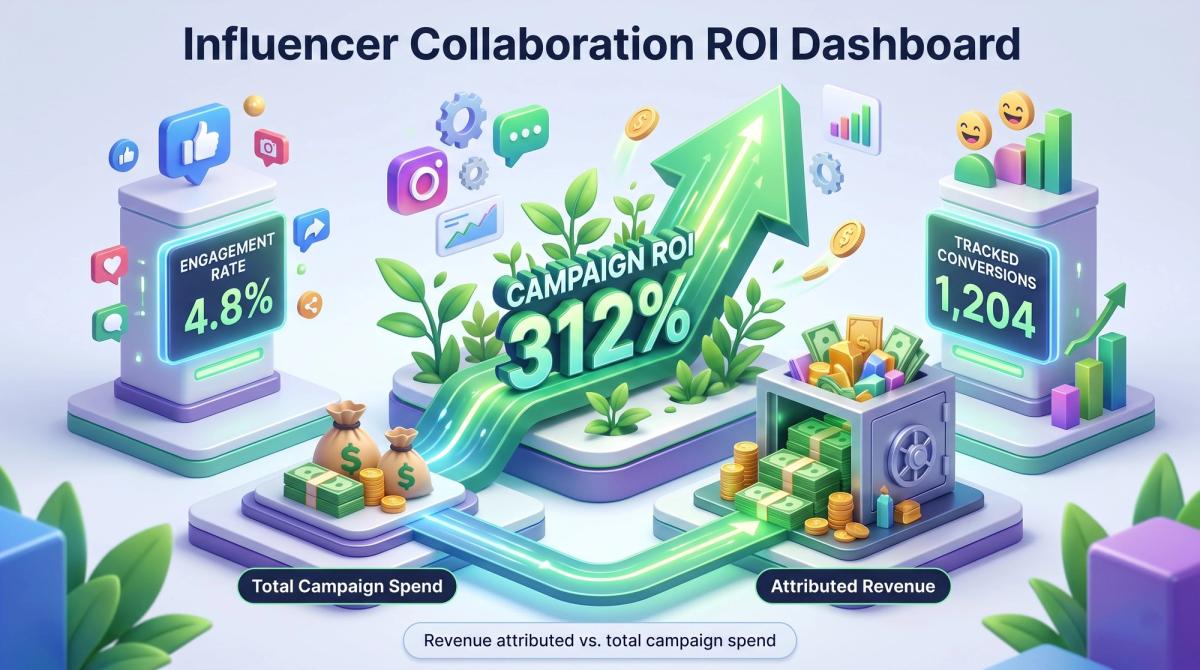
Influencer collaboration ROI is the ratio between the value a brand gets from an influencer partnership and what it costs to run that partnership. "Value" can mean direct revenue, qualified leads, app installs, or for earlier-stage brand campaigns a defensible proxy like earned media value or cost per engaged user.
The important distinction is between activity and outcome. Follower counts, likes, and impressions are activity. Signups, trial starts, and closed revenue are outcomes. ROI measurement only works when you tie the two together with a consistent tracking method, which is exactly where most teams fall short.
Why Influencer ROI Matters More for Tech and B2B Brands
Consumer brands can sometimes get away with vague "brand lift" arguments because purchase cycles are short. Tech, SaaS, and B2B companies don't have that luxury. Your buyer might see a creator's post today and sign up for a trial six weeks later, after three more research sessions and a demo call. That longer, messier funnel is exactly why disciplined measurement matters more here, not less.
It also matters because the audience is more skeptical. Developers, testers, and CTOs don't respond well to hype-driven promotion they respond to specific, technical, credible content. That changes which creators you pick and which platforms you prioritize. A well-run LinkedIn marketing partnership with a respected engineer or industry analyst often outperforms a much larger consumer influencer, purely because the audience trust is higher and the funnel is shorter to a qualified lead.
The Influencer ROI Formula
At its simplest, influencer ROI is calculated the same way you'd calculate ROI for any marketing channel:
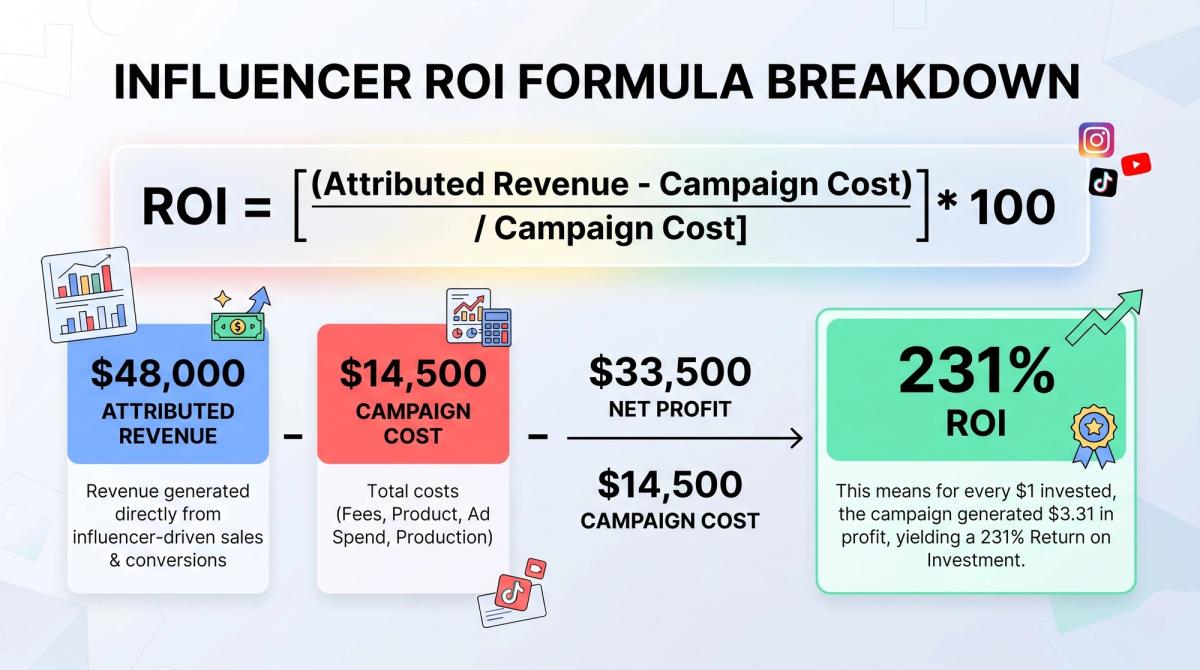
ROI (%) = [(Revenue Attributed to Campaign − Total Campaign Cost) / Total Campaign Cost] × 100"Total campaign cost" should include everything: the creator's fee, product or credits given for free, any paid amplification spend, and the internal hours your team spent briefing, coordinating, and reporting. Teams that only count the influencer's invoice consistently overstate their ROI.
Key Metrics That Feed Into ROI
ROI is a summary number, but it's built from several underlying metrics. Track these consistently across every collaboration so campaigns become comparable over time.
Engagement Rate
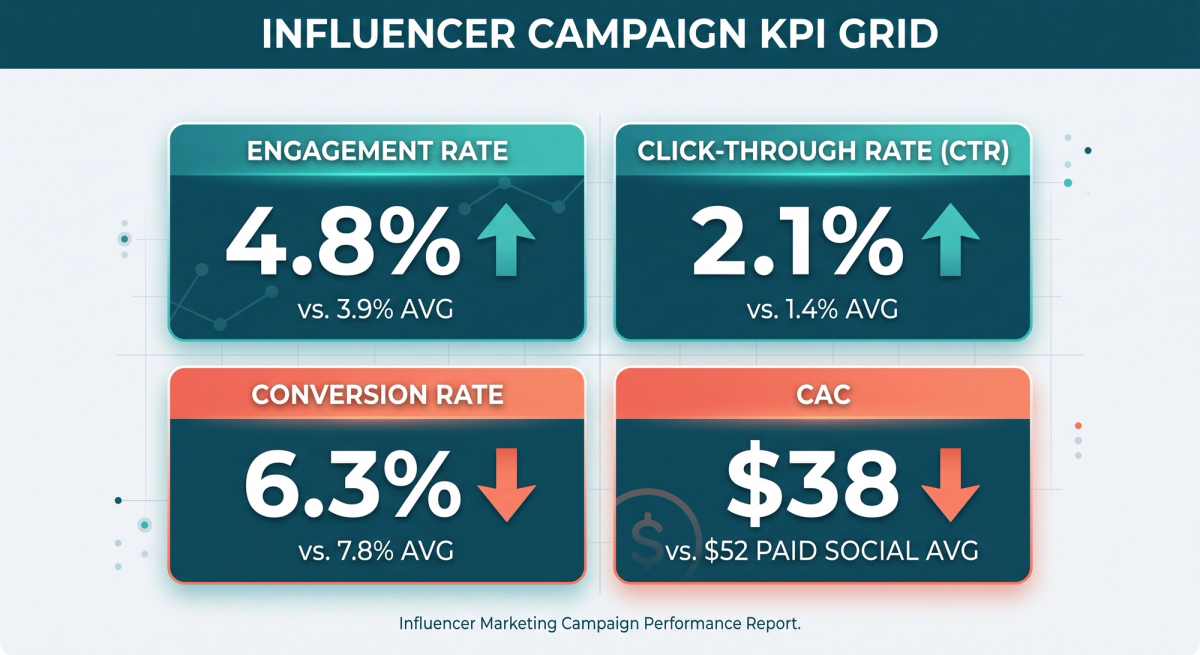
Likes, comments, shares, and saves divided by reach or follower count. On its own, engagement rate doesn't prove business impact, but a sudden drop usually signals a content or audience mismatch before it shows up in your conversion numbers. This is especially useful for Instagram marketing partnerships, where the algorithm rewards early engagement velocity.
Click-Through Rate (CTR)
The percentage of viewers who click a link, swipe up, or tap a bio link. CTR is your first real signal of intent, and it's the metric most sensitive to how clearly the creator communicates the offer.
Conversion Rate
Of the people who clicked, how many completed the action you care about a signup, a demo request, a purchase. This is where B2B and SaaS teams should spend the most attention, because a high-CTR, low-conversion campaign usually means the landing page or offer doesn't match what the creator promised.
Customer Acquisition Cost (CAC)
Total campaign cost divided by the number of customers acquired. Comparing influencer CAC against your paid search or paid social CAC is one of the fastest ways to justify (or cut) an influencer budget to a CFO.
Earned Media Value (EMV)
An estimate of what the same reach and impressions would have cost as paid advertising. EMV is a useful directional number for awareness-stage campaigns, but it should never be the only metric reported it's easy to inflate and hard to tie to revenue.
Setting Up Tracking Before the Campaign Starts
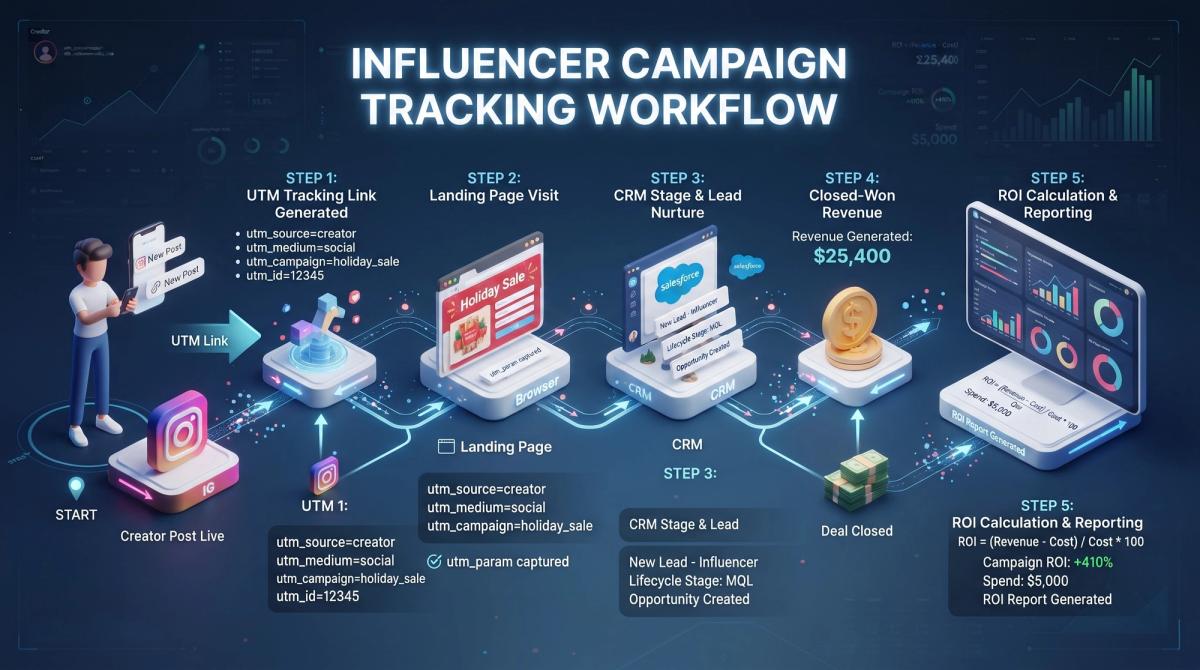
ROI measurement fails most often not because the Math is hard, but because tracking wasn't set up before launch. Build this into your workflow every time:
- UTM parameters - a unique UTM combination per creator, per platform, per post, so your analytics tool can separate a LinkedIn carousel from an Instagram reel.
- Unique discount codes or affiliate links - the simplest way to attribute offline-feeling conversions like app installs or phone signups back to a specific creator.
- Landing page instrumentation - a dedicated landing page per major campaign makes it far easier to isolate conversion rate from your general traffic.
- Cross-platform tagging - if the same creator posts on Instagram, Facebook, and LinkedIn, tag each channel separately; performance almost always varies by platform even with identical content.
- A single source of truth dashboard - pull UTM data, code redemptions, and CRM-stage data into one place rather than reconciling three spreadsheets after the fact. For technical teams: if your product has an API or event-tracking layer, pass the UTM or referral parameter through to your signup and activation events. This lets you connect an influencer post not just to a signup, but to activation and retention the metrics that actually predict revenue.
The Influencer Funnel: From Awareness to Retention
Most ROI conversations stop at the conversion event, but the strongest influencer programs keep measuring after the sale. A creator whose audience converts well but churns fast is not actually a good long-term investment, even if the first-touch ROI number looks impressive.
| Funnel Stage | What to Measure | Why It Matters |
|---|---|---|
| Awareness | Reach, impressions, engagement rate | Confirms the content actually reached the intended audience |
| Engagement | CTR, comments, saves | Signals genuine interest, not just passive viewing |
| Conversion | Signups, trials, purchases, CAC | The first hard, revenue-linked outcome |
| Retention | 30/60/90-day retention, LTV | Reveals whether the acquired audience was actually a good fit |
Common Mistakes That Skew ROI Measurement
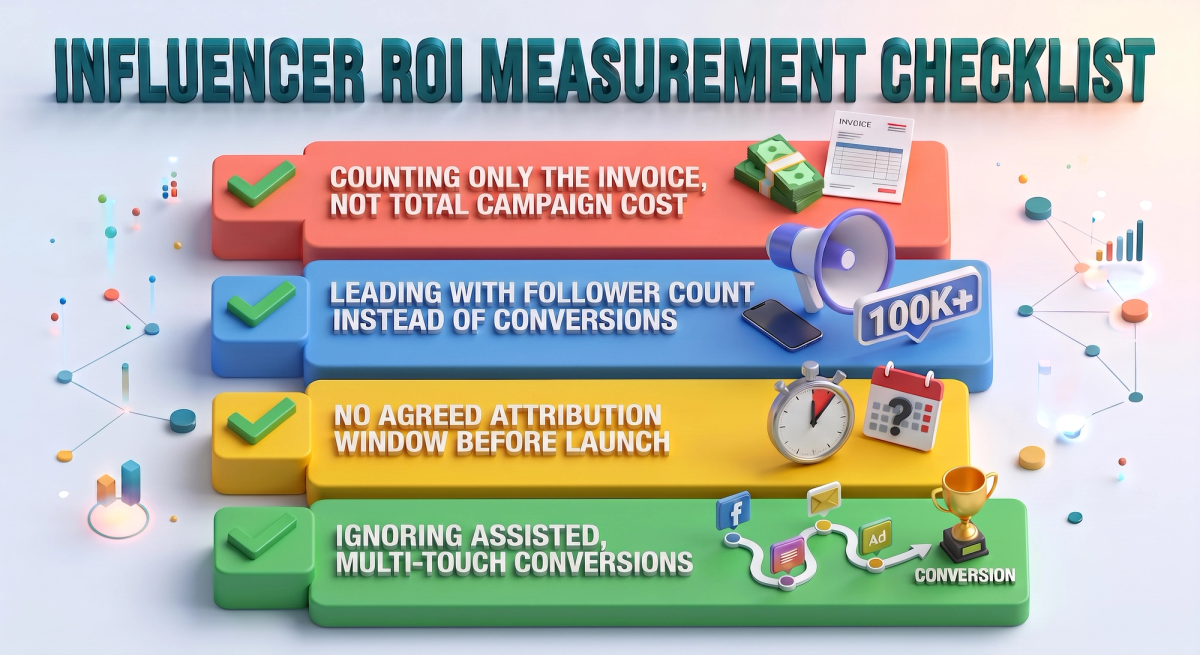
- Counting only the invoice as cost. Free product, internal hours, and paid boosting all belong in the denominator.
- Using vanity metrics as the headline number. Follower count and impressions describe reach, not results.
- No pre-agreed attribution window. Decide upfront whether you're crediting conversions within 7, 14, or 30 days of the post otherwise every report becomes a debate.
- Ignoring assisted conversions. A buyer who saw an influencer post and later converted via a Google search should still be partly credited to that post; multi-touch attribution avoids underselling top-of-funnel creators.
- Comparing campaigns with different goals. An awareness campaign and a conversion campaign shouldn't be judged on the same ROI scale.
A Worked Example: A B2B SaaS Company
A mid-sized SaaS company partnered with three technical creators to promote a new feature. Each creator received a unique UTM-tagged link and a dedicated promo code. Over a 30-day attribution window, the campaign generated 1,204 tracked link clicks, 187 trial signups, and 22 paid conversions, for $48,000 in attributed first-year revenue against $14,500 in total cost a 231% ROI.
The more useful insight came from segmenting by creator: one partnership drove the most clicks but the lowest conversion rate, while a smaller-audience creator converted at nearly triple the rate. Without platform-level and creator-level tracking, the team would have renewed the wrong partnership the following quarter.
How Cinute InfoMedia Helps Brands Measure and Improve Influencer ROI
At Cinute InfoMedia, we treat influencer collaborations as a measurable channel, not a one-off experiment. Our social media marketing team builds the tracking architecture UTM structures, promo codes, and dashboards before a single post goes live, so ROI reporting is never an afterthought.
Because attribution rarely lives in one tool, we connect campaign data with your broader performance marketing stack, so influencer-driven traffic is compared fairly against paid search and paid social CAC. And since a creator's audience only converts if what they land on matches the promise, our content and SEO writing team makes sure landing pages and supporting content hold up to a technical, research-driven audience.
The result is a program you can defend in a budget review: clear metrics, a consistent formula, and a record of which creators actually move revenue not just impressions.
Want a clearer picture of your influencer ROI?
We'll audit your current tracking setup and show you exactly where attribution is leaking free of charge. Request a Free Audit.
Final Thoughts
Influencer collaboration ROI isn't complicated Math it's disciplined setup. Agree on cost, agree on attribution windows, tag everything before launch, and keep measuring past the first conversion. Do that consistently, and influencer marketing stops being a leap of faith and starts being a channel you can plan a budget around. For more measurement frameworks like this one, browse the rest of our digital marketing blog.
Related Articles
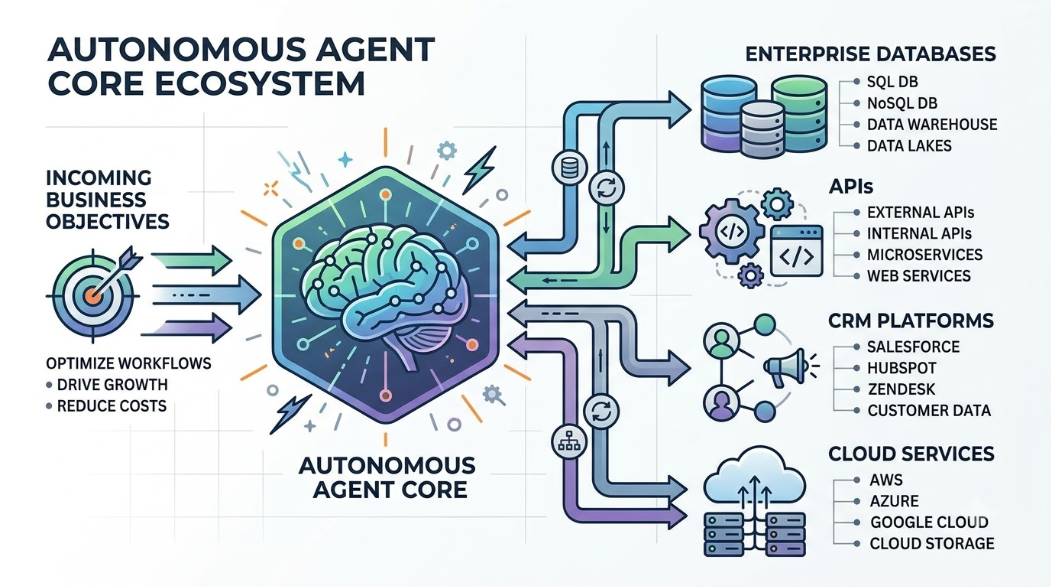
What Are AI Agents? How They Work, Benefits, Architecture, and Enterprise Adoption
A comprehensive guide for technology leaders exploring the shift from conversational chatbots to autonomous AI agents. Learn the core architecture, 8-stage operational lifecycle, high-impact enterprise use cases, integration patterns, security risks, and multi-layered testing frameworks required to deploy agentic automation responsibly.

SEO Monitoring Tools: Technical Implementation Guide for Developers
Comprehensive technical guide to SEO monitoring tools designed for software developers and product managers. Learn how to integrate monitoring into development workflows, track technical SEO metrics, and automate performance reporting with modern tools and APIs.

Core Web Vitals Fixes Guide: Complete Technical Implementation for Developers
Master Core Web Vitals optimization with our technical implementation guide. Learn LCP, FID, CLS fixes with code examples and strategies tailored for developers and CTOs.