
Table of Contents
In a store, a shopper can pick a product up, feel the weight of it, turn it over. Online, none of that exists until the parcel lands on the doorstep. That makes e-commerce packaging design the single physical touchpoint in an otherwise digital relationship, and the first thing a new customer experiences with their own hands. Treated well, it does the job a salesperson would: it reassures, it delights, and it earns the next order.
Most online brands still think of the box as a shipping cost. The ones that grow fastest treat it as owned media a branded moment that arrives, guaranteed, in the customer's home. This guide walks through what e-commerce packaging design actually is, the anatomy of a package that converts, how to engineer the unboxing experience, and a repeatable process you can brief a designer with.
01- The stakes Why packaging is a growth lever, not a line item
The economics are simple. Acquiring a customer is expensive; keeping one is cheap. Packaging is one of the few brand assets that reaches every paying customer at the exact moment their excitement peaks the moment the parcel arrives. A forgettable brown box lets that moment pass. A considered one converts a first-time buyer into someone who remembers your name.
It also compounds with everything else you're already investing in. The care you put into your store's UX and checkout flow shouldn't evaporate the second someone clicks "buy." Packaging is the offline continuation of that experience and for many shoppers, it's the part they photograph and share.
Packaging is the only marketing channel that is delivered, unwrapped, and kept reaching 100% of buyers with zero extra media spend.
02- Definition What is e-commerce packaging design?
E-commerce packaging design is the practice of designing product packaging specifically for items that are bought online and shipped directly to the customer as opposed to retail packaging built to compete on a crowded store shelf. The two look similar but solve very different problems.
Retail packaging fights for attention against dozens of neighbours under fluorescent light. Custom packaging design for online stores has no shelf to win the sale is already made. Instead it has three new jobs: survive the journey, protect the product, and turn delivery into a branded experience worth remembering. That shift changes everything about the materials, the structure, and the graphics you choose.
- It has to travel. A mailer box or shipping carton gets dropped, stacked and rained on. Structure and material come before decoration.
- It's opened alone. There's no store associate the package has to communicate your brand entirely on its own.
- It's a marketing surface. Interior print, insert cards and seals are advertising space you already paid to ship.
03- The buildThe anatomy of high-converting packaging
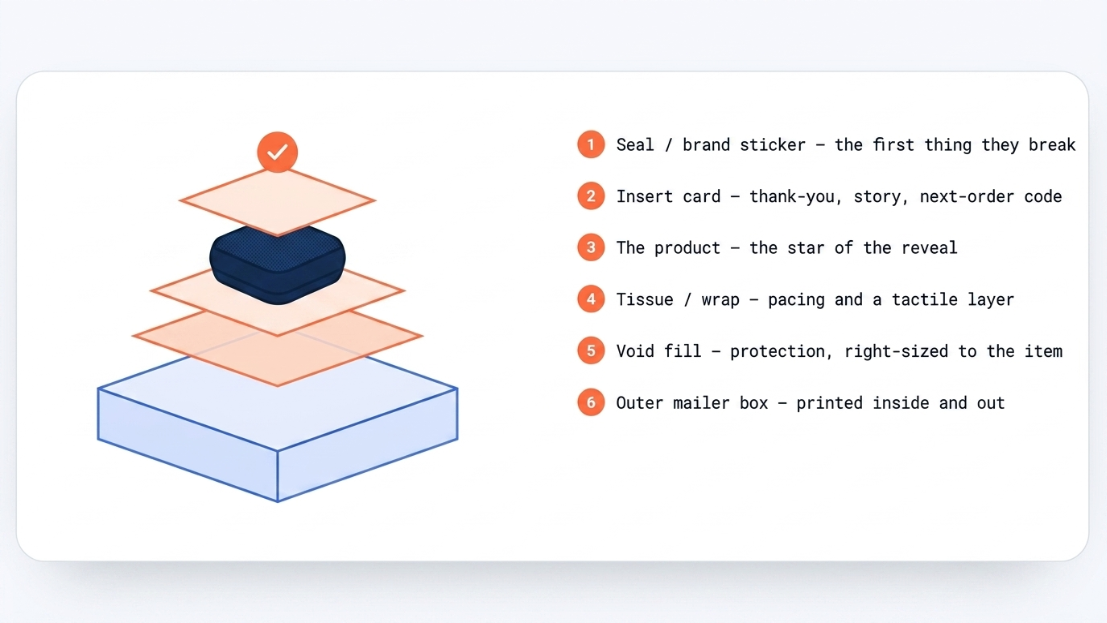
Strong custom packaging design works on three layers at once. Get the order right structure first, brand second, extras last and the package feels premium without feeling wasteful.
The structural layer
This is the engineering: the outer mailer or corrugated shipping box, the right-sized cavity, and the void fill that stops the product rattling. It starts with a dieline the flat cut-and-fold template every printer works from. Right-sizing here isn't just tidy; an oversized box costs more to ship and screams "afterthought" the moment it's opened.
The brand layer
Now the surfaces do their work: exterior print, interior print (the "surprise" side most brands forget), your logo, brand colours, tissue, and a seal or sticker. This is where packaging becomes an extension of your visual identity rather than a generic carton. Consistency matters more than flourish the box should feel like it came from the same world as your website.
The functional-delight layer
Finally, the small human touches: an easy-open pull tab, a thank-you insert, a discount card for the next order, a QR code to a how-to video. None of these are decoration each one either reduces friction (returns, support) or drives a measurable action (repeat purchase, review, referral).
■ Designer's rule
Spend on structure and one signature detail. A perfectly right-sized box with a single memorable touch beats an over-decorated one that arrives dented.
04- The momentDesigning the unboxing experience
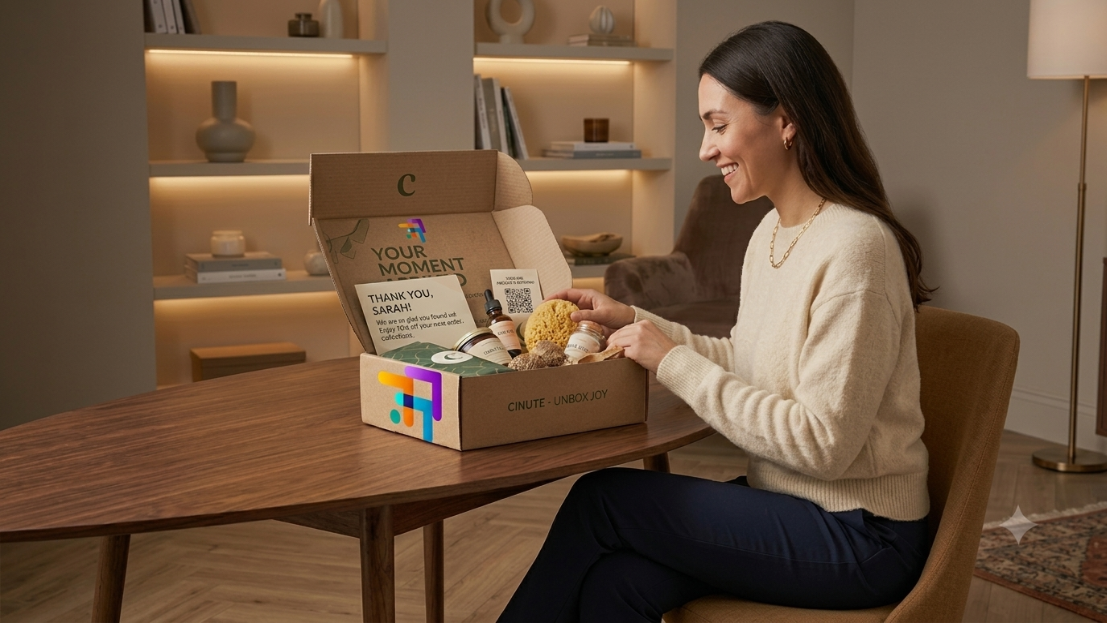
The unboxing experience is the choreography of opening the sequence, the pacing, the reveal. Good packaging design controls the order in which things are discovered: break the seal, lift the lid, part the tissue, meet the product, find the note. Each step buys a second of anticipation, and anticipation is what turns a transaction into a memory.
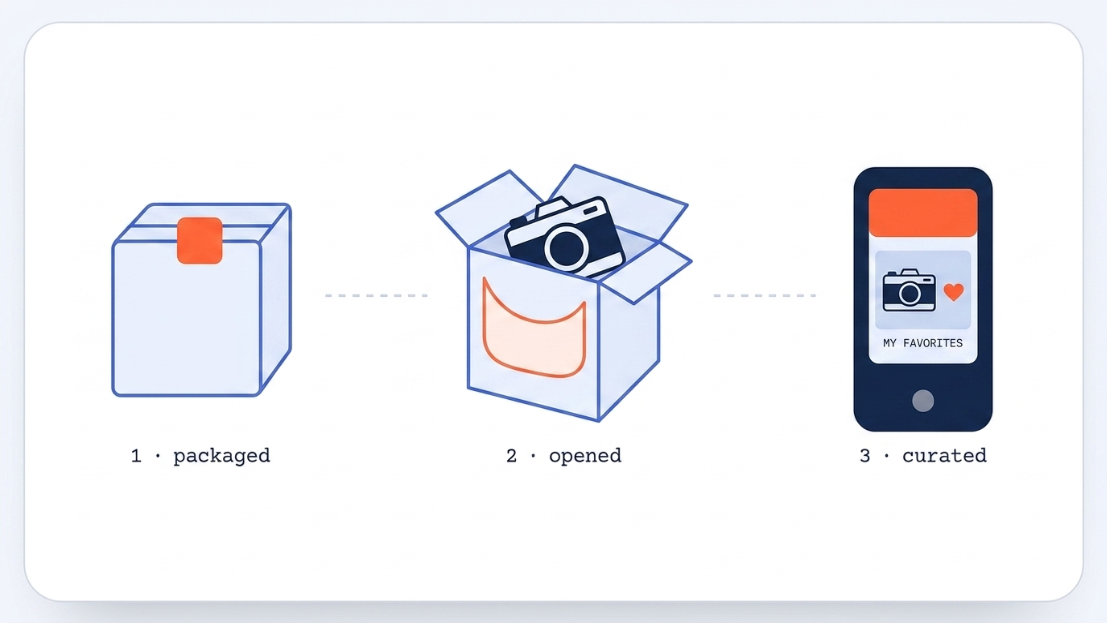
This is also where packaging quietly becomes a marketing channel. A genuinely delightful unboxing is the kind of thing people film and post turning your customer into a creator and your box into content. If you're already investing in social media marketing, packaging that's built to be photographed multiplies every campaign with authentic, user-generated reach you didn't have to pay for.
1×
The only brand touch that reaches every single buyer, in their home.
+LTV
A memorable unbox nudges the second order the cheapest revenue you'll ever earn.
UGC
Shareable packaging converts customers into content creators for free.
05- AlignmentMake packaging an extension of your brand identity
Packaging fails when it feels disconnected from everything else a slick website, then a random beige box. Every element of your packaging should trace back to the same system that governs your logo, palette and typography. That system is exactly what brand identity design exists to define: the colours, marks and voice that make you recognisable across web, mobile, print and, yes, the parcel.
Practically, that means your packaging pulls its HEX colours, fonts and logo lockups straight from your brand guidelines no improvising at the print stage. It doesn't matter whether you sell on a custom build, a Shopify store, or a headless setup; the box has to feel like it belongs to the same brand the customer just bought from online. Cohesion is what makes a young brand feel established.
The website makes the promise. The packaging keeps it in the customer's hands.
06- Responsibility Sustainable e-commerce packaging design
Sustainability has moved from "nice to have" to a baseline expectation, especially for the audiences most online brands are chasing. Sustainable packaging design isn't only about the material it's about using less of it, and choosing what remains wisely.
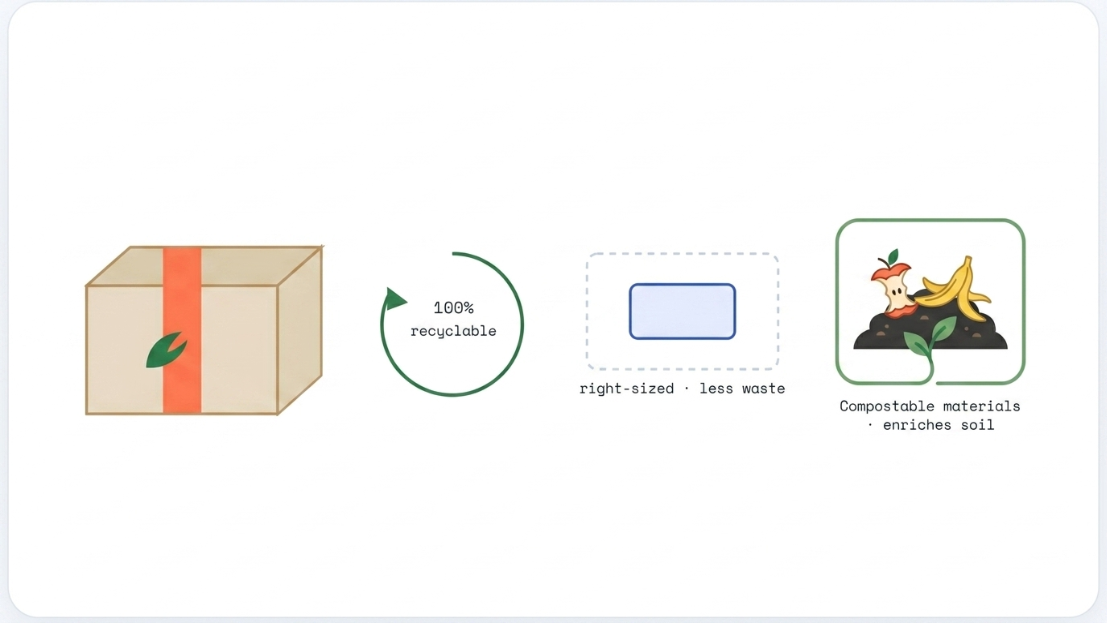
- Right-size ruthlessly. The greenest and cheapest packaging is the box you didn't oversize. Less void fill, lower shipping weight, less waste.
- Choose recyclable or recycled materials. Corrugated kraft, paper tape, and mono-material mailers are easy for customers to actually recycle.
- Design for a second life. A beautiful box people reuse for storage keeps your brand in their home far longer than a bin liner.
- Say it, don't shout it. A small, honest note about your materials builds more trust than a giant green leaf that overpromises.
07- The methodA 6-step e-commerce packaging design process
You don't need to reinvent this. A good packaging project moves through the same six stages every time the same logic our team applies across brand identity work.
- Discovery & audit. Understand the product, the customer, shipping realities and the existing brand. Define what the package must protect and what it must say.
- Structure & dieline. Choose the format (mailer, carton, poly-mailer), right-size it to the product, and produce the dieline the printer will use.
- Visual design. Apply brand colours, logo, typography and interior print. Design the insert card and seal as part of the system, not afterthoughts.
- Prototype. Order a physical sample. Ship it to yourself. Drop it. Open it. Nothing on screen predicts how a box actually feels in the hand.
- Production. Hand off print-ready files with correct bleed, dielines and material specs; confirm colour proofs before the full run.
- Measure & iterate. Watch repeat-purchase rate, returns, review volume and social mentions. Refine the details that move those numbers.
08- Pitfalls Common packaging mistakes to avoid
- The oversized box. Wasteful, costly, and an instant letdown when a small item rattles inside a cavern.
- The invisible brand. Plain cartons with a shipping label are a missed advertisement you already paid to deliver.
- Style over survival. Beautiful packaging that arrives crushed does more damage than a plain box that protects.
- Forgetting returns. If a customer can't easily re-close the box, your returns experience and your reviews suffer.
- No next step. Skipping the insert wastes prime space. A QR code linking to reviews or a reorder page is free, and it feeds your e-commerce SEO and retention at once.
09- The payoff How packaging design impacts conversions & retention
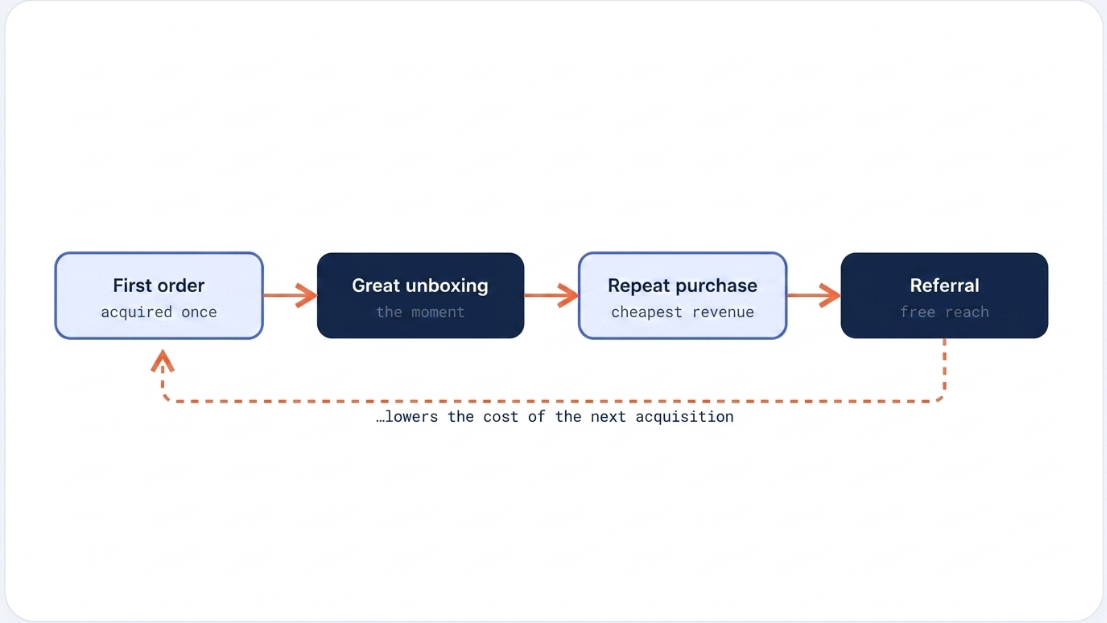
Packaging doesn't win the first sale the product page and the ad did that. What it wins is everything after: the second order, the review, the story a customer tells a friend. Those are the levers that quietly lower your blended acquisition cost, because a buyer who comes back doesn't need to be re-acquired.
That's why smart brands treat packaging as part of the same growth stack as their e-commerce store and their paid channels. When your unboxing consistently earns repeat purchases and referrals, every dollar of performance marketing stretches further you're not just buying customers, you're keeping them.
FAQ E-commerce packaging design questions
Q. How much does e-commerce packaging design cost? It depends on scope. Designing a single branded mailer with an insert is modest; a full system multiple box sizes, tissue, tape, inserts and guidelines is a larger project. Physical unit costs then depend on material, print method and order volume, where quantity brings the price per box down. The best approach is to brief the goal and budget and design to fit.
Q. What's the best packaging for a small online store? Start simple and right-sized: a well-fitted branded mailer box or a printed poly-mailer, one interior print detail, and a thank-you insert. You don't need five formats on day one you need one that protects the product and clearly looks like your brand.
Q. Does packaging design really affect sales? Not the first sale but strongly the ones after it. Packaging is the touchpoint that drives repeat purchase, reviews and word-of-mouth, which is where most e-commerce profit actually lives. It's a retention and brand tool more than an acquisition one.
Q. How do I make packaging sustainable without raising costs too much? Right-sizing is the win that saves money and material at the same time. Combine it with recyclable mono-materials like corrugated kraft and paper tape, and label your choices honestly. You rarely need premium eco-materials everywhere you need less packaging, chosen well.
Q. What files does a packaging printer need? Print-ready artwork on the correct die-line, with proper bleed and margins, colours specified for the print method, and material and finish specs. Always approve a physical proof before the full run screen colour and paper colour are never identical. Brand Identity Design
Make every box feel like your brand.
From die-line to delivered, our brand team designs packaging that protects your product, extends your identity, and turns first-time buyers into regulars.
Book a free brand audit →Explore Brand Identity Design e-commerce packaging design unboxing experience brand identity sustainable packaging© 2026 Cinute InfoMedia · Brand Identity Design
Related Articles

Analytics for Bot Performance: How to Measure, Improve and Prove Your Chatbot's Value
Your chatbot is live, but is it working? This guide explains analytics for bot performance in plain language: the metrics that matter, how to set up tracking, and how to turn conversation data into better answers, lower costs and measurable ROI.
Technical SEO Audit Checklist 2026: The Complete Step-by-Step Guide
A technical SEO audit finds the hidden problems that stop search engines from crawling, rendering and ranking your pages. This 2026 checklist walks developers, testers, CTOs and marketers through every step, from crawlability and Core Web Vitals to structured data and AI search readiness.
Logo Design Trends 2026: 8 Shifts Every Tech Brand Must Know
Logos now work like small pieces of software. Discover the 8 logo design trends of 2026, from adaptive systems to motion and dark-mode palettes, plus a technical checklist for developers and marketers.