
Table of Contents
Every rupee or dollar of your advertising budget has to earn its place. For small and medium businesses running paid search, the question used to be simple: Google Ads, obviously. But in 2026, that answer deserves a second look.
Microsoft Ads (formerly Bing Ads) has quietly evolved into a serious contender. Lower cost-per-click, a growing user base, and deep integration with LinkedIn audience data have made it a platform that budget-conscious SMBs can no longer afford to ignore.
So which platform actually wins for your business? Let's break it down honestly.
What Are Microsoft Ads and How Do They Work?
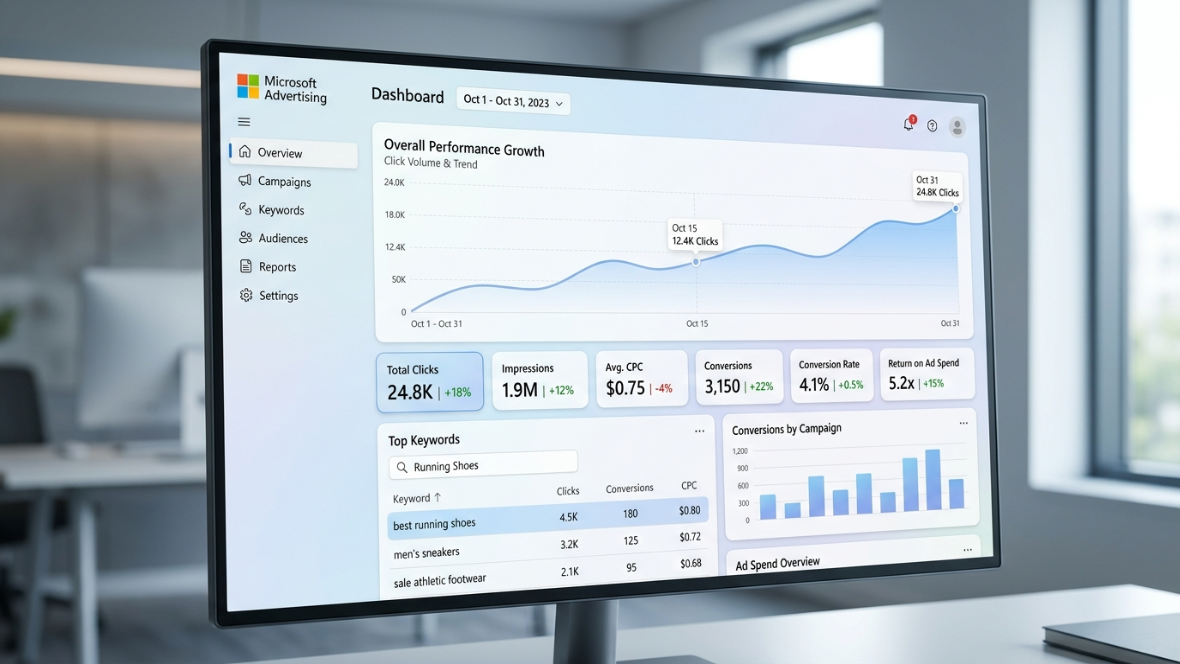
Microsoft Ads is the pay-per-click advertising platform that serves ads across Bing, Yahoo, MSN, DuckDuckGo, and a network of partner sites. You bid on keywords, write ad copy, set a budget, and pay only when someone clicks the same fundamental model as Google Ads.
The difference lies in where those ads show up, who sees them, and what you pay to reach them.
The Case for Google Ads in 2026
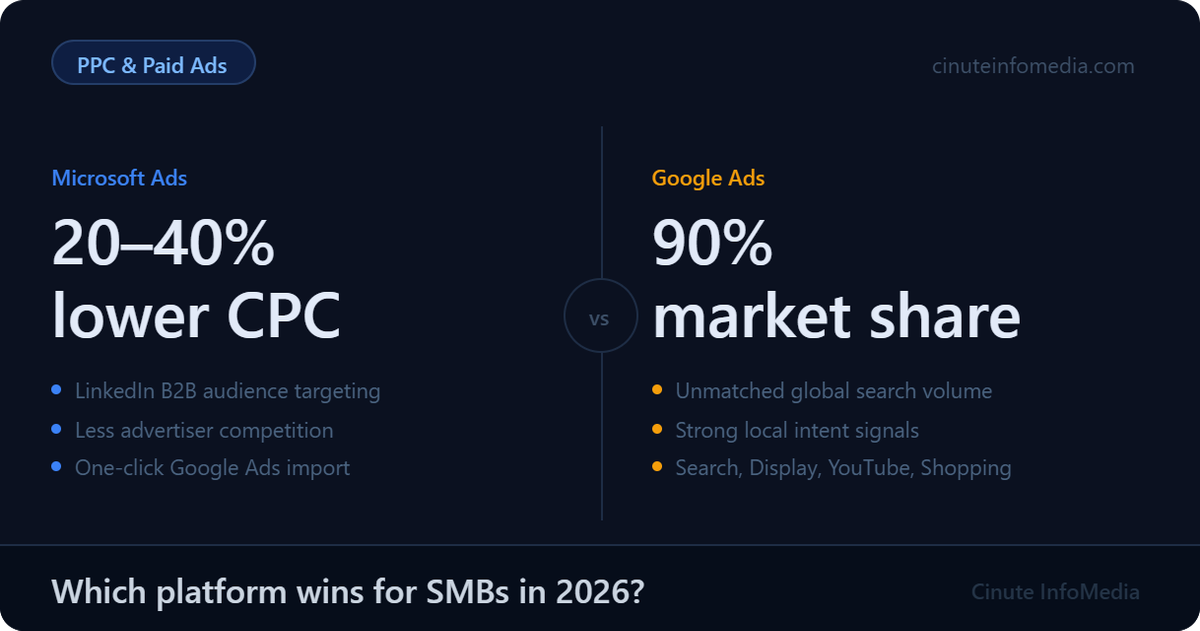
Google holds roughly 90% of the global search engine market. No platform comes close in terms of raw reach. For an SMB trying to get in front of the largest possible audience, Google Ads is the default starting point and for good reason.
Where Google wins:
Unmatched search volume. Google processes over 8.5 billion searches per day. If your product or service has any meaningful search demand, Google gives you access to the widest top of the funnel available in digital advertising.
Mature ecosystem. Google Ads has the most advanced auction system, the broadest targeting options (Search, Display, Shopping, YouTube, Performance Max), and the deepest analytics integration with Google Analytics 4. For businesses with complex campaigns or multiple product lines, the toolset is unrivalled.
Strong local intent signals. Google Maps integration and location-based targeting make it the go-to choice for SMBs with a physical presence — restaurants, clinics, retail outlets, and service providers who rely on foot traffic.
The downside for SMBs: Competition on Google is fierce. In high-intent categories like legal services, insurance, real estate, and software, CPCs can run anywhere from ₹50 to ₹500+ per click in India, and significantly higher in Western markets. For an SMB with a modest daily budget, this can mean very few clicks, very little data, and frustrating return on ad spend.
The Case for Microsoft Ads for Small Business in 2026
Microsoft Ads has been underestimated for years. That's beginning to change and SMBs who got in early are reaping the rewards.
Where Microsoft Ads wins:
Lower CPCs - significantly. Across most industries, Microsoft Ads delivers CPCs that are 20–40% lower than Google Ads for equivalent keywords. In competitive verticals like finance, B2B software, and professional services, the gap can be even wider. For an SMB with a tight budget, this means more clicks, more data, and more chances to convert for the same spend.
Higher-income, older audience. Bing users skew older (35–65) and more affluent than the average Google user. If your product targets professionals, homeowners, business decision-makers, or anyone in middle-to-senior income brackets, Bing's audience profile is a natural fit. Research consistently shows Bing users have higher household incomes and are more likely to make purchases online.
LinkedIn audience targeting. This is Microsoft Ads' secret weapon for B2B businesses. Because Microsoft owns LinkedIn, you can layer LinkedIn profile data job title, company size, industry, seniority onto your search campaigns. No other search platform offers this. For an SMB selling software, consulting, HR tools, or anything aimed at business buyers, this targeting capability alone can justify the switch.
Less competition. Fewer advertisers compete on Bing for most keywords. This directly translates into lower CPCs, higher average ad positions, and a better shot at the top placement even with a smaller budget.
Import from Google Ads in minutes. Microsoft Ads lets you import your entire Google Ads campaign structure keywords, ad copy, bid strategies, extensions in a few clicks. For SMBs who already have a working Google Ads setup, there is almost no barrier to running both platforms in parallel.
Microsoft Ads vs Google Ads: A Direct Comparison for SMBs
| Factor | Google Ads | Microsoft Ads |
|---|---|---|
| Search market share | ~90% globally | ~6–8% globally |
| Average CPC | Higher (varies by industry) | 20–40% lower on average |
| Audience size | Much larger | Smaller but targeted |
| Audience profile | Broad | Older, higher-income |
| B2B targeting | Limited | LinkedIn data integration |
| Competition | Very high | Moderate to low |
| Setup complexity | Advanced | Mirrors Google Ads structure |
| Google import | N/A | One-click campaign import |
| Best for | High-volume, B2C, local | B2B, budget-conscious, professional services |

Real-World ROI: What SMBs Are Seeing in 2026
Across Cinute InfoMedia's client base and industry benchmarks, a consistent pattern emerges when SMBs run both platforms simultaneously:
Microsoft Ads typically delivers a lower cost-per-lead in B2B and professional service categories. Google Ads wins on volume and is essential for e-commerce and high-frequency consumer purchases. The highest-performing SMB ad accounts we see are running both Google for volume and brand reach, Microsoft for efficiency and B2B targeting.
A healthcare services provider in India running parallel campaigns found their Microsoft Ads cost-per-appointPPC strategy and campaign managementment booking was nearly 35% lower than Google, despite Bing delivering less than 15% of the traffic. The quality of the lead, measured by appointment show-up rates, was actually higher on Microsoft.
A B2B SaaS company targeting HR managers in mid-sized Indian firms used Microsoft's LinkedIn job-title targeting to serve ads exclusively to HR Director and CHRO-level decision-makers. The conversion rate on that segment was three times their Google Ads average, at roughly half the CPC.
These are not anomalies. They reflect a structural advantage that budget-conscious SMBs can reliably exploit.
Should You Use Microsoft Ads, Google Ads, or Both?
The honest answer depends on your business type, budget, and goals. Here is a practical framework:
Start with Google Ads if:
- You are a local business that relies on Google Maps visibility
- Your product is consumer-facing with high search volume (e-commerce, food delivery, retail)
- You have the budget to compete in your category (generally ₹500–₹1,000/day minimum for meaningful data)
- You need maximum reach and are not primarily targeting B2B buyers
Add Microsoft Ads (or start here) if:
- Your monthly ad budget is under ₹30,000–₹50,000 and you need every click to count
- You are targeting business decision-makers, professionals, or higher-income consumers
- You are in a competitive vertical where Google CPCs are eating your budget alive
- You already have a Google Ads campaign you can import in minutes
- You want to test a new product or market with lower financial risk
Run both if:
- You have a budget that allows it (even ₹500/day on Microsoft is enough to generate meaningful data)
- You want to cross-platform test ad copy and landing page performance
- You serve both B2C and B2B audiences
5 Practical Tips to Get the Most from Microsoft Ads for Small Business
1. Import your Google Ads campaigns immediately. Do not start from scratch. Use the native import tool, then adjust bids downward by 20–30% to account for lower competition. Monitor for the first two weeks and optimise from there.
2. Use LinkedIn audience layering for B2B. In your campaign settings, add LinkedIn profile targets start with job function and seniority. Use observation mode first to see performance data before switching to targeting mode, which restricts reach.
3. Bid on competitor brand terms. Competition on Bing is lower, which means competitor brand keywords are significantly cheaper than on Google. If a competitor runs heavy Google Ads, there is a real opportunity to intercept their audience on Bing at a fraction of the cost.
4. Don't neglect ad extensions. Sitelinks, callouts, structured snippets, and call extensions improve both CTR and Quality Score on Microsoft Ads, exactly as they do on Google. Many SMBs import their campaigns but forget to import or rebuild extensions.
5. Monitor search partner performance. Microsoft Ads serves ads on Yahoo, DuckDuckGo, and partner sites as well as Bing. Check the Campaigns > Performance by Network report regularly. If search partners are delivering poor-quality traffic, you can exclude them with one checkbox.
The Verdict: Which Platform Wins for SMBs in 2026?
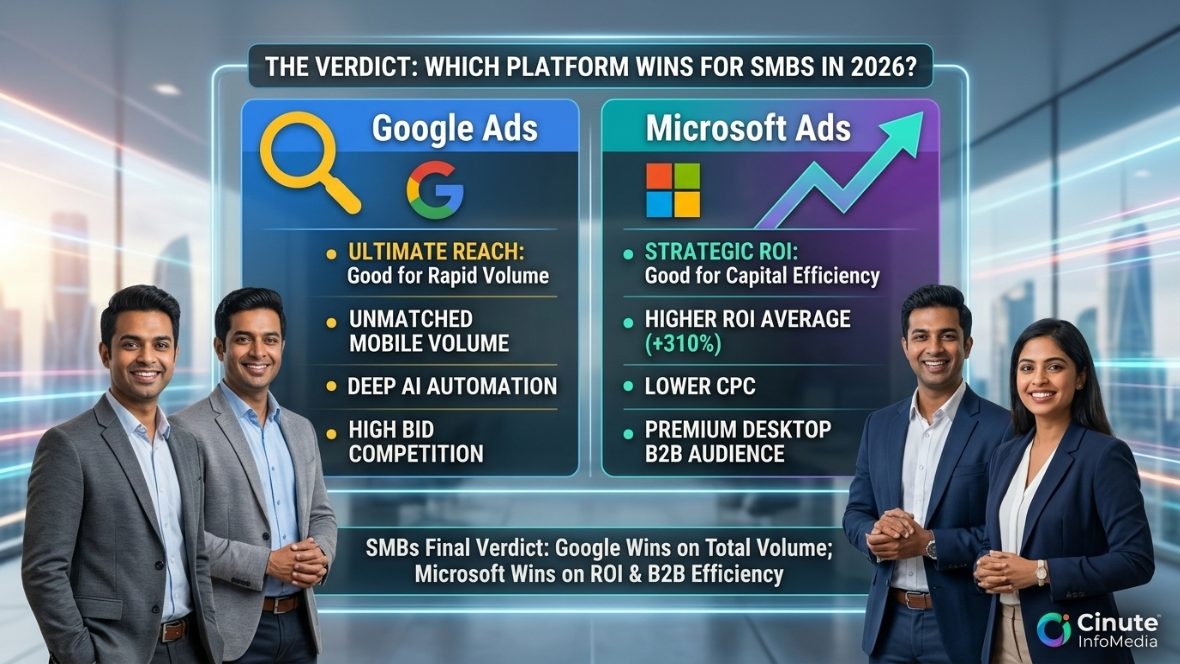
Google Ads wins on reach. Microsoft Ads wins on efficiency.
For most SMBs especially those operating in India, targeting professionals, or working with limited daily budgets Microsoft Ads for small business deserves far more attention than it currently gets. The combination of lower CPCs, reduced competition, and LinkedIn's B2B targeting data creates a structural cost advantage that is difficult to replicate anywhere else in paid search.
The smartest approach is not an either/or choice. Start with Google Ads if you need volume and local visibility. Layer in Microsoft Ads as soon as your budget allows even a modest allocation will likely deliver a lower cost-per-lead in most B2B and professional service categories.
In 2026, the SMBs seeing the best PPC results are not the ones spending the most on Google. They are the ones being strategic about where every click is purchased.
Frequently asked questions
Q. Is Microsoft Ads worth it for small businesses in India?
Yes, especially for B2B companies, professional services, and businesses with limited daily budgets. Microsoft Ads consistently delivers CPCs that are 20–40% lower than Google Ads across most Indian market categories. The Bing audience in India skews toward older, higher-income users and corporate professionals who actively make purchase decisions. If your product or service targets that demographic, the ROI from Microsoft Ads can outperform Google even with a fraction of the traffic volume. It is not a replacement for Google but it is a high-efficiency complement that most Indian SMBs are currently overlooking.
Q. What is the minimum budget to start Microsoft Ads?
Microsoft Ads has no mandatory minimum spend you can technically start with ₹500 per day. However, to collect enough click data to optimise meaningfully, a daily budget of ₹800–₹1,500 is a practical starting point for most Indian SMBs. In Western markets, $10–$20 per day is a reasonable entry point. Because CPCs on Microsoft are lower than Google, your budget stretches further giving you more conversion events to learn from even at modest spend levels. Most SMBs see usable performance data within the first 3–4 weeks.
Q. Can I run Microsoft Ads and Google Ads at the same time?
Absolutely and most SMBs who do report better overall results than running either platform in isolation. Google handles volume and local intent; Microsoft handles efficiency and B2B targeting. The one-click import tool in Microsoft Ads lets you clone your existing Google campaigns in minutes, so there is minimal extra setup. A common budget split is 70–80% Google / 20–30% Microsoft, then shift allocation over time based on which platform delivers the lower cost-per-lead for your specific business and category.
Q. How does LinkedIn targeting work in Microsoft Ads?
Because Microsoft owns LinkedIn, Microsoft Ads lets you layer LinkedIn profile data directly onto your search campaigns. You can target by job title, job function, seniority level, company name, company size, and industry all within the Microsoft Ads interface. For example, an HR software company could restrict ads to appear only when searched by HR Directors at companies with 50–500 employees. It is available in two modes: Observation (you collect performance data without restricting reach) and Targeting (ads show only to matching profiles). Always start with Observation to gather data before switching to Targeting mode.
Q. What types of businesses benefit most?
Microsoft Ads delivers the strongest results for B2B companies selling to professionals or corporate buyers, financial services and insurance providers, legal and consulting firms, real estate agencies, education and e-learning platforms, and healthcare providers. These categories benefit from Bing's older, higher-income audience and LinkedIn's professional targeting. E-commerce businesses selling mass-market consumer goods typically see better primary results with Google Shopping though adding Microsoft Shopping as a supplement can still reduce blended CPC meaningfully across the account.
Ready to Launch Your Microsoft Ads Campaign?
Cinute InfoMedia specialises in PPC strategy and campaign management for growing businesses. Whether you are starting your first Microsoft Ads campaign or optimising an existing one, our team can help you build a setup that maximises return on every rupee of your budget.
Get in touch with Cinute InfoMedia to discuss your paid search strategy.
Related Articles
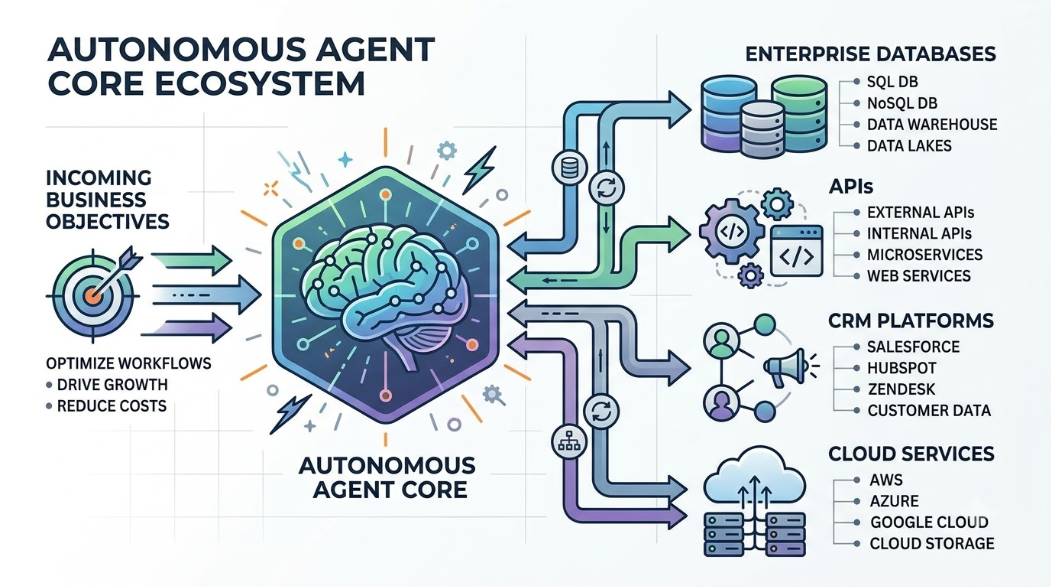
What Are AI Agents? How They Work, Benefits, Architecture, and Enterprise Adoption
A comprehensive guide for technology leaders exploring the shift from conversational chatbots to autonomous AI agents. Learn the core architecture, 8-stage operational lifecycle, high-impact enterprise use cases, integration patterns, security risks, and multi-layered testing frameworks required to deploy agentic automation responsibly.
SEO Monitoring Tools: Technical Implementation Guide for Developers
Comprehensive technical guide to SEO monitoring tools designed for software developers and product managers. Learn how to integrate monitoring into development workflows, track technical SEO metrics, and automate performance reporting with modern tools and APIs.

Core Web Vitals Fixes Guide: Complete Technical Implementation for Developers
Master Core Web Vitals optimization with our technical implementation guide. Learn LCP, FID, CLS fixes with code examples and strategies tailored for developers and CTOs.