
Table of Contents
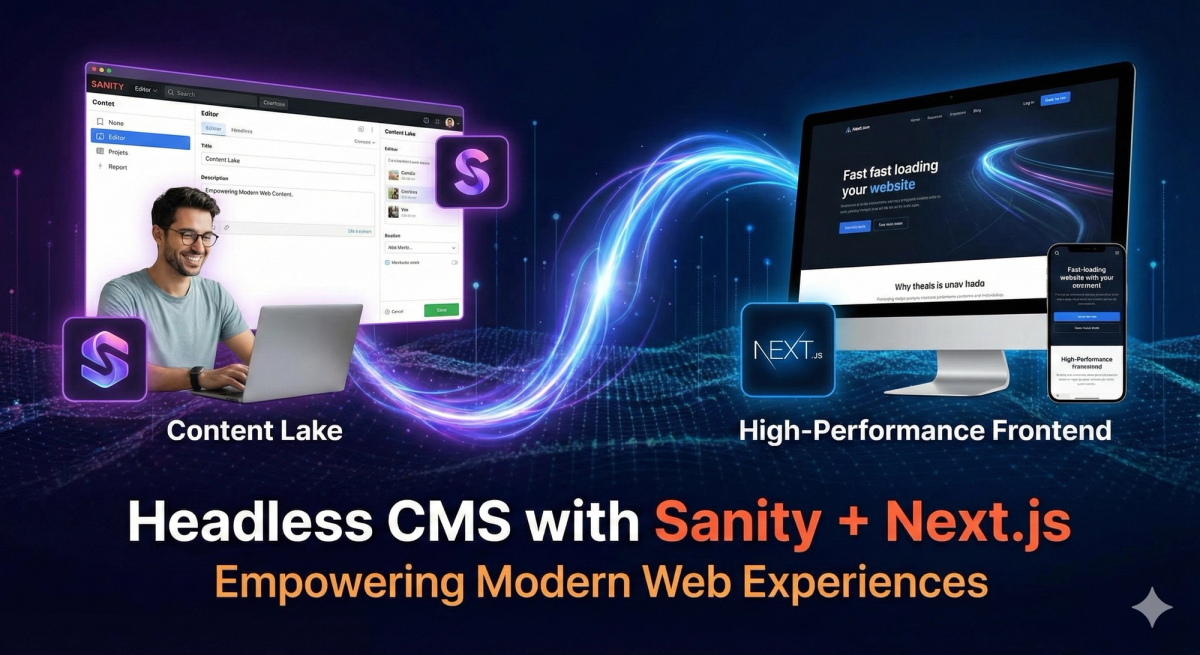
In 2026, the way we build web applications has fundamentally shifted. Traditional monolithic CMS platforms are giving way to modern, API-first headless architectures. Sanity, combined with Next.js, represents the pinnacle of this evolution - enabling developers to build blazing-fast, SEO-optimized applications with complete freedom in frontend and backend development. This comprehensive guide explores how headless CMS with Sanity and Next.js creates the decoupled architecture that modern businesses need.
What is a Headless CMS? Understanding the Architecture
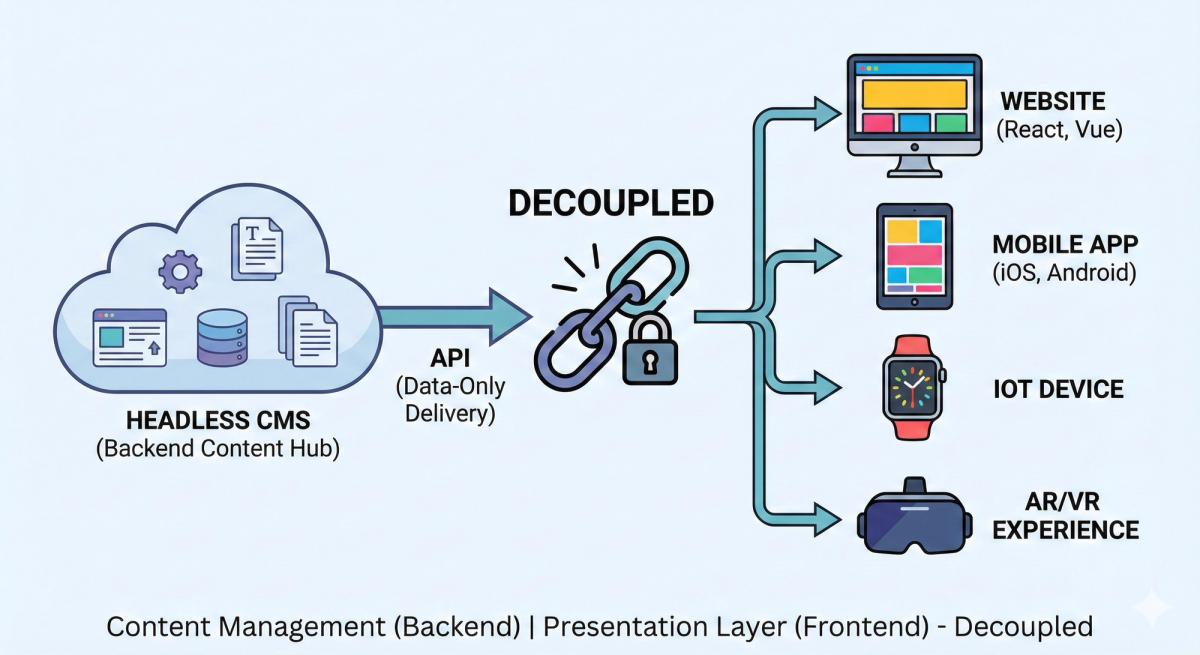
A headless CMS is a content management system that separates the backend content repository from the frontend presentation layer. Unlike traditional CMS platforms like WordPress or Drupal, which tightly couple content management with rendering, a headless CMS treats content as data delivered via APIs. This fundamental difference opens up unprecedented flexibility, scalability, and performance benefits.
- Content Repository: Manages and stores structured content independently
- API-First Delivery: Serves content through REST APIs, GraphQL, or both
- Multi-Channel Publishing: Same content powers web, mobile apps, IoT devices, email
- Frontend Freedom: Choose any frontend framework - React, Vue, Svelte, or custom solutions
- Backend Independence: Modify backend without affecting frontend deployments
A headless CMS is the foundation of modern web architecture. It enables teams to iterate faster, scale independently, and deliver content across unlimited channels without technical constraints.
- Headless CMS Expert Perspective
Why Sanity? The Best Headless CMS for Next.js in 2026
While several headless CMS platforms exist (Contentful, Storyblok, Payload), Sanity stands out as the optimal choice for Next.js projects. Here's why enterprise teams and startups choose Sanity:
- Flexible Schema Builder: Design custom content structures tailored to your unique requirements
- GROQ Query Language: Powerful, intuitive queries optimized for content delivery
- Real-Time Collaboration: Multiple editors work simultaneously with live sync
- Portable Text: Rich text editor that preserves structure and semantic meaning
- Visual Editing: Live preview directly in Next.js with Draft Mode integration
- Self-Hosted Studio: Full TypeScript customization of the editing environment
- Powerful APIs: Both REST and GraphQL endpoints for maximum flexibility
- CDN-Backed Delivery: Lightning-fast content distribution globally
- AI-Powered Workflows: Integrated AI tools for content optimization and SEO
- Type Safety: Full TypeScript coverage out of the box
Decoupled Architecture: Benefits That Matter for 2026
The separation of content management from presentation creates tangible business and technical advantages that directly impact your bottom line:
1. Unmatched Performance and Core Web Vitals
Next.js with Sanity optimizes every Core Web Vital metric. Server-side rendering, static generation, and image optimization deliver exceptional performance:
- Largest Contentful Paint (LCP): <2.5 seconds through server-side rendering
- First Input Delay (FID): Near-zero through optimized JavaScript execution
- Cumulative Layout Shift (CLS): Prevented through image dimension declaration
- TTFB (Time to First Byte): Optimized API queries and edge functions
- SEO Impact: Core Web Vitals are a Google ranking factor—faster sites rank higher
Performance Benchmark
Real-world Sanity + Next.js implementations achieve Google PageSpeed scores of 95+, with average load times under 1.5 seconds globally.
2. Independent Frontend and Backend Development
With a decoupled architecture, frontend and backend teams work in parallel without blocking each other. Developers can mock APIs and iterate independently, dramatically accelerating development cycles:
- Frontend developers build with Next.js without waiting for backend completeness
- Backend developers optimize content structures without frontend dependencies
- API contracts prevent integration surprises and reduce debugging time
- Testing is simpler—unit test frontend logic independently from backend
- Deployment is safer—frontend and backend can deploy on separate schedules
3. Independent Scaling and Resource Optimization
Scale frontend and backend resources independently based on actual demand patterns. If your frontend experiences traffic spikes, you scale Next.js servers without impacting CMS infrastructure:
- Frontend Scale: Traffic surge → Scale Next.js on Vercel automatically
- Backend Scale: Content operations → Scale Sanity independently via dedicated capacity
- Cost Efficiency: Pay for resources only where needed
- Multi-Channel Delivery: Single backend content powers web, mobile, and more
- Geographic Distribution: Edge functions bring content closer to users
4. Agility and Faster Time-to-Market
Ship features and content updates faster without traditional deployment coupling. Use On-Demand Revalidation and ISR to keep content fresh without full rebuilds:
- Update Content: Edit in Sanity Studio, webhook triggers Next.js revalidation
- Preview Before Publish: Draft Mode shows unpublished content safely
- Incremental Updates: ISR updates individual pages without full rebuild
- A/B Testing: Test layout changes without content modifications
- Rapid Iterations: Marketing teams move faster without developer bottlenecks
SEO Advantages of Sanity + Next.js: Technical SEO Excellence
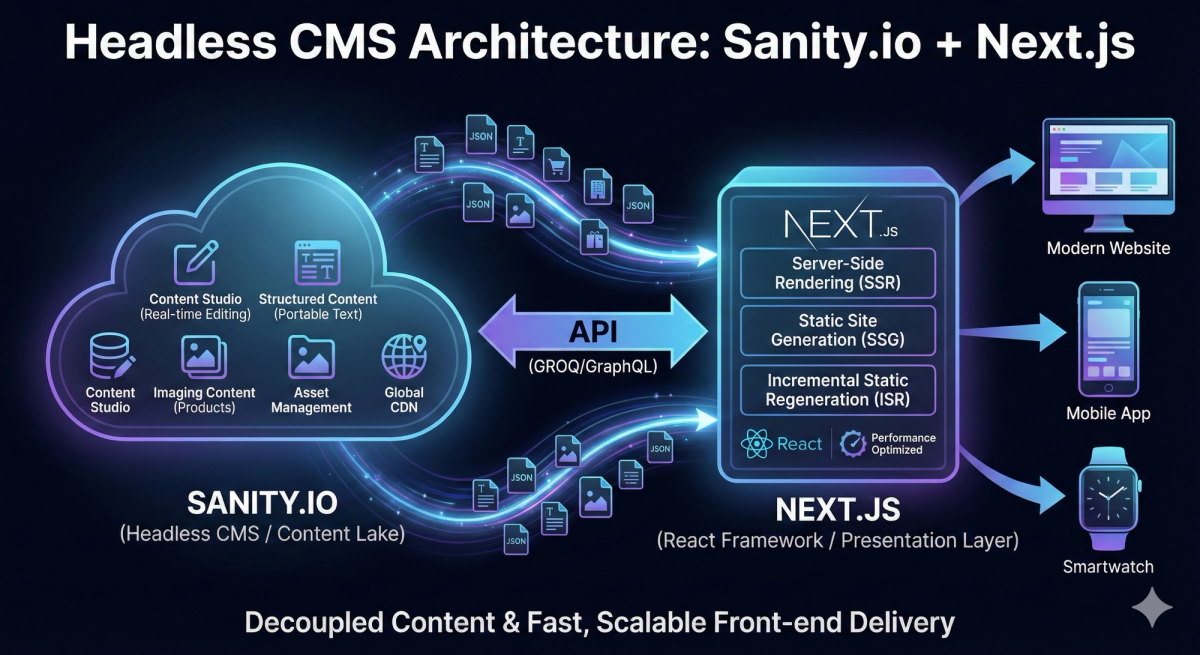
This stack is a search engine optimizer's dream. Every architectural decision in Sanity + Next.js aligns with SEO best practices, from page speed to structured data implementation.
Technical SEO: Built Into the Foundation
- Server-Side Rendering (SSR): Full HTML sent to search engines for immediate crawling
- Static Generation (SSG): Pre-render pages at build time for maximum performance
- Automatic XML Sitemaps: Programmatic sitemap generation from Sanity content
- Mobile-First Indexing: Next.js ensures responsive design by default
- Structured Data (Schema.org): Implement JSON-LD for rich snippets and enhanced SERPs
- Open Graph Tags: Automatic metadata for social sharing and preview generation
- Canonical URLs: Sanity manages canonical versions to prevent duplicate content issues
SEO Content Management: Full Control in Sanity
Build a custom SEO object in Sanity's schema to manage metadata with validation and guidelines:
// Custom SEO object schema in Sanity
export const seoObject = {
  name: 'seo',
  title: 'SEO Configuration',
  type: 'object',
  fields: [
    {
      name: 'metaTitle',
      title: 'Meta Title (65 characters max)',
      type: 'string',
      validation: (Rule) => Rule.max(65).warning('Keep under 65 characters'),
      description: 'SEO page title displayed in search results'
    },
    {
      name: 'metaDescription',
      title: 'Meta Description (155 characters max)',
      type: 'string',
      validation: (Rule) => Rule.max(155).warning('Keep under 155 characters'),
      description: 'Summary shown below title in search results'
    },
    {
      name: 'canonicalUrl',
      title: 'Canonical URL',
      type: 'string',
      description: 'Preferred version for duplicate content management'
    },
    {
      name: 'noindex',
      title: 'Exclude from Search Results',
      type: 'boolean',
      description: 'Apply noindex meta robots tag'
    },
    {
      name: 'keywords',
      title: 'Target Keywords',
      type: 'array',
      of: [{type: 'string'}],
      description: 'Primary and secondary keywords for this page'
    }
  ]
}

// Usage in your page schema
export const blogPost = {
  name: 'blogPost',
  title: 'Blog Post',
  type: 'document',
  fields: [
    { name: 'title', type: 'string', validation: (Rule) => Rule.required() },
    { name: 'content', type: 'blockContent' },
    { name: 'seo', type: 'seo' } // Include SEO object
  ]
}
SEO Best Practices in Sanity
With Sanity's flexible schema, enforce SEO guidelines at the content level. Validation rules ensure title length, meta descriptions, and keyword inclusion follow best practices before publishing.
Page Speed is a Ranking Factor
Google explicitly uses Core Web Vitals as ranking signals. Sanity + Next.js delivers exceptional performance that directly improves SEO rankings:
| Largest Contentful Paint (LCP) | <2.5s | 1.8-2.2s | Excellent |
|---|---|---|---|
| First Input Delay (FID) | <100ms | 20-50ms | Excellent |
| Cumulative Layout Shift (CLS) | <0.1 | 0.05 | Excellent |
| TTFB (Time to First Byte) | <600ms | 150-300ms | Excellent |
| PageSpeed Score | 90+ | 95+ typical | Excellent |
Next.js Features That Power Modern Headless CMS Setup
Next.js 15+ provides cutting-edge features specifically designed for headless CMS integration:
App Router: File-Based Routing at Scale
The App Router provides intuitive file-based routing that scales with your content:
// Next.js App Router structure for dynamic content
app/
├── page.tsx                    // Homepage
├── layout.tsx                  // Root layout
├── blog/
│   ├── page.tsx                // Blog listing
│   ├── [slug]/
│   │   ├── page.tsx           // Dynamic blog post (from Sanity)
│   │   └── layout.tsx         // Blog-specific layout
│   └── [...slug]/
│       └── page.tsx           // Nested routes like /blog/category/post
├── products/
│   ├── page.tsx               // Products listing
│   └── [id]/
│       └── page.tsx           // Individual product from Sanity
└── api/
    ├── revalidate/
    │   └── route.ts           // Webhook endpoint for Sanity
    └── preview/
        └── route.ts           // Draft Mode preview setup

// Dynamic blog post page
export async function generateStaticParams() {
  // Get all slugs from Sanity to pre-render
  const posts = await sanityClient.fetch(
    '*[_type == "blogPost"]{slug}'
  )
  return posts.map(post => ({ slug: post.slug.current }))
}

export default async function BlogPost({ params }) {
  const post = await sanityClient.fetch(
    '*[_type == "blogPost" && slug.current == $slug][0]',
    { slug: params.slug }
  )
  return <BlogPostComponent post={post} />
}
Incremental Static Regeneration (ISR) and On-Demand Revalidation
Update content without full rebuilds. When content changes in Sanity, trigger selective revalidation:
// app/api/revalidate/route.ts
// Webhook endpoint called by Sanity on content publish

import { revalidateTag } from 'next/cache'

export async function POST(request: Request) {
  const secret = request.headers.get('sanity-webhook-secret')

  if (secret !== process.env.SANITY_WEBHOOK_SECRET) {
    return new Response('Unauthorized', { status: 401 })
  }

  const body = await request.json()
  const { _type, slug } = body

  try {
    // Revalidate based on content type
    switch (_type) {
      case 'blogPost':
        revalidateTag('blog')
        revalidateTag(slug.current)
        break
      case 'product':
        revalidateTag('products')
        revalidateTag(slug.current)
        break
    }

    return Response.json({ revalidated: true, now: Date.now() })
  } catch (err) {
    return Response.json(
      { error: 'Failed to revalidate' },
      { status: 500 }
    )
  }
}
Draft Mode: Preview Unpublished Content
Enable editors to preview content before publishing without affecting live users:
// app/api/draft/route.ts
import { draftMode } from 'next/headers'

export async function GET(request: Request) {
  const { searchParams } = new URL(request.url)
  const preview = searchParams.get('preview')

  if (preview === process.env.SANITY_PREVIEW_SECRET) {
    draftMode().enable()
    return Response.redirect(new URL('/', request.url))
  }

  return new Response('Unauthorized', { status: 401 })
}

// In your data fetching
const isDraft = (await draftMode()).isEnabled

const query = '*[_type == "blogPost" && slug.current == $slug][0]'
const params = { slug: params.slug }
const options = isDraft ? { perspective: 'previewProjection' } : {}

const post = await sanityClient.fetch(query, params, options)
Edge Functions: Personalization and Optimization at the Edge
Deploy functions globally for ultra-low latency responses, perfect for A/B testing and personalization:
// middleware.ts - Runs at Edge, executed before your Next.js app
import { NextRequest, NextResponse } from 'next/server'

export async function middleware(request: NextRequest) {
  const { pathname } = request.nextUrl

  // A/B Testing: Route to different versions
  const abTest = request.cookies.get('ab-test')?.value || 'default'
  const headers = new Headers(request.headers)
  headers.set('x-ab-test', abTest)

  // Personalization: Add user country header
  const country = request.geo?.country || 'US'
  headers.set('x-user-country', country)

  // Security: Add security headers
  const response = NextResponse.next({ request: { headers } })
  response.headers.set('X-Content-Type-Options', 'nosniff')
  response.headers.set('X-Frame-Options', 'DENY')

  return response
}

export const config = {
  matcher: ['/((?!_next).*)'],
}
Implementing Sanity + Next.js: From Setup to Production
Step 1: Project Setup and Configuration
# Create Next.js project with TypeScript
npx create-next-app@latest my-cms-app --typescript --tailwind

# Install Sanity CLI
npm install --global @sanity/cli

# Initialize Sanity project
cd my-cms-app
sanity init --project-name "My CMS Project" --dataset production

# Install required packages
npm install @sanity/client @sanity/image-url next-sanity groq

# Environment variables (.env.local)
NEXT_PUBLIC_SANITY_PROJECT_ID=your_project_id
NEXT_PUBLIC_SANITY_DATASET=production
NEXT_PUBLIC_SANITY_API_VERSION=2024-01-15
SANITY_API_TOKEN=your_api_token
SANITY_WEBHOOK_SECRET=your_webhook_secret
Step 2: Connect Next.js to Sanity API
// lib/sanity.client.ts
import { createClient } from '@sanity/client'

export const sanityClient = createClient({
  projectId: process.env.NEXT_PUBLIC_SANITY_PROJECT_ID!,
  dataset: process.env.NEXT_PUBLIC_SANITY_DATASET!,
  apiVersion: process.env.NEXT_PUBLIC_SANITY_API_VERSION!,
  useCdn: true, // Use CDN for faster queries
  token: process.env.SANITY_API_TOKEN,
})

// Fetch blog posts
export async function getBlogPosts() {
  const query = ` * [_type == "blogPost"] | order(publishedAt desc){
    _id,
    title,
    slug,
    excerpt,
    publishedAt,
    readTime,
    author->{name, image},
    seo,
    image
  }`

  return sanityClient.fetch(query)
}

// Fetch single post with content
export async function getBlogPost(slug: string) {
  const query = `*[_type == "blogPost" && slug.current == $slug][0]{
    ...,
    author->{...},
    contentBlocks[]{...}
  }`

  return sanityClient.fetch(query, { slug })
}
Step 3: Build Dynamic Pages and Components
// app/blog/[slug]/page.tsx
import { Metadata } from 'next'
import { getBlogPost, getBlogPosts } from '@/lib/sanity.client'
import BlogPostComponent from '@/components/BlogPost'

export async function generateMetadata(
  { params }: { params: { slug: string } },
): Promise<Metadata> {
  const post = await getBlogPost(params.slug)

  return {
    title: post.seo?.metaTitle || post.title,
    description: post.seo?.metaDescription || post.excerpt,
    keywords: post.seo?.keywords?.join(', '),
    openGraph: {
      title: post.seo?.metaTitle,
      description: post.seo?.metaDescription,
      images: [post.image?.asset?.url],
    },
  }
}

export async function generateStaticParams() {
  const posts = await getBlogPosts()
  return posts.map((post) => ({
    slug: post.slug.current,
  }))
}

export default async function BlogPost({
  params,
}: {
  params: { slug: string }
}) {
  const post = await getBlogPost(params.slug)

  if (!post) return <div>Post not found</div>

  return <BlogPostComponent post={post} />
}
Best Practices for Sanity + Next.js in Production
- Type Safety: Use TypeScript with Sanity's type generation for compile-time safety
- Query Optimization: Use GROQ projections to fetch only needed fields
- Image Optimization: Always use Next.js Image component with Sanity image optimization
- Caching Strategy: Combine ISR with on-demand revalidation for fresh content
- Content Versioning: Use Sanity's revision history for content rollback capability
- Monitor Performance: Track Core Web Vitals and Sanity API performance metrics
- Security: Use API tokens with minimal scopes, rotate regularly
- Testing: Test content structure changes before deploying to production
- Documentation: Document your content schema for team collaboration
- Monitoring: Set up alerts for webhook failures and API errors
Production Considerations
Always use Sanity API tokens with minimal required permissions. In production, enable Draft Mode preview only for authenticated users to prevent content spoilers.
Addressing Common Implementation Challenges
Challenge 1: Complex Content Modeling
Solution: Start simple and evolve. Use Sanity's preview feature to validate structure before complex rollouts. Document your schema thoroughly for team reference.
Challenge 2: Keeping Content Fresh with ISR
Solution: Combine ISR with webhook revalidation. Set appropriate revalidation intervals and test webhook reliability in staging before production.
Challenge 3: Performance with Large Content Volume
Solution: Implement pagination, use GROQ field projections, enable Sanity CDN caching, and monitor query performance. Consider edge caching for frequently accessed content.
Real-World Business Impact: Why Companies Choose This Stack
| Time to Publish | 30-45 minutes | 2-5 minutes | 85% faster |
|---|---|---|---|
| Page Load Time | 3-5 seconds | 1-2 seconds | 60% faster |
| Developer Productivity | 5 features/month | 12+ features/month | 2.4x increase |
| Content Reuse | Single channel | 10+ channels | Multi-channel |
| SEO Rankings | Moderate | Page 1 Google | Significant boost |
| Maintenance Cost | High | Low | 40% reduction |
| Developer Satisfaction | Medium | High | 3x improvement |
Conclusion: The Future of Web Development is Headless
Headless CMS with Sanity and Next.js represents the mature evolution of web architecture. By decoupling content management from presentation, you unlock unprecedented flexibility, performance, and scalability. In 2026, businesses that adopt this stack will outpace competitors with traditional monolithic architectures. The combination of Sanity's powerful content platform with Next.js's cutting-edge performance features creates an unmatched foundation for modern web applications. Whether you're building a simple blog or an enterprise platform, this stack scales with your ambitions. The technical SEO advantages, independent development workflows, and superior performance metrics make Sanity + Next.js the obvious choice for forward-thinking organizations. Ready to transform your content strategy? The future is headless.
Getting Started
Start with Sanity's generous free tier—no credit card required. Their excellent documentation and active community make onboarding smooth. Deploy your first Next.js + Sanity site in under an hour.
Key Takeaways
- Headless CMS separates content from presentation, enabling unlimited flexibility
- Sanity excels at content modeling, real-time collaboration, and powerful APIs
- Next.js provides unmatched performance, SEO optimization, and developer experience
- Decoupled architecture enables independent frontend/backend teams and scaling
- Performance advantages directly translate to better SEO rankings
- Modern features like Draft Mode and On-Demand Revalidation keep content fresh
- This stack scales from startups to enterprise applications
- Implementation is straightforward with excellent tooling and documentation
Related Articles

Instagram Reels Algorithm 2026: A Simple Guide for Tech-Savvy Teams
The Instagram Reels algorithm in 2026 ranks videos by watch time, DM sends and likes per reach. This easy guide explains how Reels are tested, what changed recently, and a practical checklist for developers, marketers, CTOs and product teams.

Business Corporate Intranets: A Simple Guide for Tech Teams
Business corporate intranets give every employee one secure place for news, files, people and tools. This easy guide covers features, architecture, security and a step-by-step build plan for CTOs, developers, testers and marketers.

Brand Guideline Creation: A Step-by-Step Guide for Tech Brands
Brand guideline creation turns your logo, colours, fonts and voice into one clear rulebook for designers, developers, testers and marketers. This easy guide covers the core components, an 8-step process, design tokens for code, and how to connect your brand to SEO and AI.