

Table of Contents
For enterprise engineering teams and technical marketing directors scaling operations across the globe, digital advertising can no longer be treated as a creative guessing game. In 2026, Data-Driven Meta Ads Creative Testing is fundamentally a rigorous data engineering and quality assurance (QA) challenge. By deploying autonomous testing workflows and treating your ad account like a continuous integration/continuous deployment (CI/CD) pipeline, CTOs and Product Managers can systematically validate creative assets, eliminate the technical debt associated with broken tracking, and scale their marketing infrastructure globally without geographic constraints.
To maintain a competitive edge, relying on manual ad uploading and unstructured A/B testing is insufficient. The future demands intelligent, self-healing systems. When your marketing pipelines are backed by the same rigor as your software development life cycle, you continuously validate data integrity, automate performance regression testing, and ensure every dollar spent yields statistically significant insights. This comprehensive guide explores how technical leaders can leverage these advanced workflows to accelerate speed-to-market, mitigate financial risk, and build infinitely scalable customer acquisition architectures.
The PAS Framework: Deconstructing the Marketing Data Crisis
Problem: The Bottleneck of Unstructured Testing and Manual Deployments
In an era where algorithmic machine learning dictates market dominance, engineering and marketing teams are paralyzed by fragmented data silos. As organizations scale, they aggregate unstructured campaign data from diverse global touchpoints. Processing this information via traditional Meta Ads Manager methods requires manual campaign creation, constant ad-set adjustments, and exhaustive data cleansing to find winning creatives. For a CTO or Engineering Lead overseeing revenue operations, this translates to valuable resources trapped in a cycle of reactive maintenance rather than proactive innovation. Tracking pixels misfire, undocumented rule changes break downstream analytics, and the sheer volume of creative variations overwhelms standard operational limits.

Agitation: Compounding Technical Debt and Catastrophic Ad Waste
When Data-Driven Meta Ads Creative Testing protocols are rigid or poorly architected, the financial and operational fallout is severe. A minor schema change in your website's data layer or a deprecated API endpoint can trigger a catastrophic failure across your entire enterprise advertising dashboard. This is the definition of silent technical debt in marketing. Every hour spent debugging a broken Meta Conversions API (CAPI) connection is an hour where the Meta algorithm is fed corrupted data. In high-stakes B2B environments, these data failures result in flawed algorithmic learning, compromised risk mitigation, sky-high Cost Per Acquisition (CPA), and ultimately, lost market share to competitors with superior digital infrastructure.
Solution: Applying Software QA Automation to Media Buying
The definitive solution for 2026 is the deployment of strict QA automation frameworks applied directly to your Meta Ads environment. Unlike standard media buying, which relies on human intuition, this methodology operates autonomously within defined engineering guardrails. It actively monitors API data streams, detects event-tracking anomalies, executes structured A/B tests to resolve creative edge cases, and demands statistical significance before pushing budgets to production scaling phases. By adopting this methodology, organizations achieve borderless scalability, ensuring that campaigns running in the US, UK, or APAC regions are universally structured, validated, and instantly actionable.
Strategic Implementation: Engineering the Testing Pipeline
To extract the maximum ROI from Meta Ads, technical leads must move beyond basic user interface interactions and architect programmatic, dynamic testing pipelines.
1. Dynamic Parameterization in Campaign Architecture
At the enterprise level, haphazardly launching ads is a critical financial risk. Dynamic parameterization allows your testing architecture to adapt based on structured naming conventions and automated rules.
A true Data-Driven Meta Ads Creative Testing framework requires a modular approach akin to object-oriented programming. You do not test an entire video at once; you isolate variables.
- The Hook (First 3 seconds): Treated as the front-end user interface. Does it capture attention?
- The Body: The core logic and value proposition.
- The Call to Action (CTA): The execution command.
Pro-Tip: Always utilize structured UTM parameterization that maps directly to your backend CRM or internal data warehouse. Breaking the data lineage prematurely forces the analytical engine to rely solely on Meta's in-platform reporting, devastating your ability to calculate true downstream LTV (Lifetime Value).
2. Mastering the Meta Conversions API (CAPI)
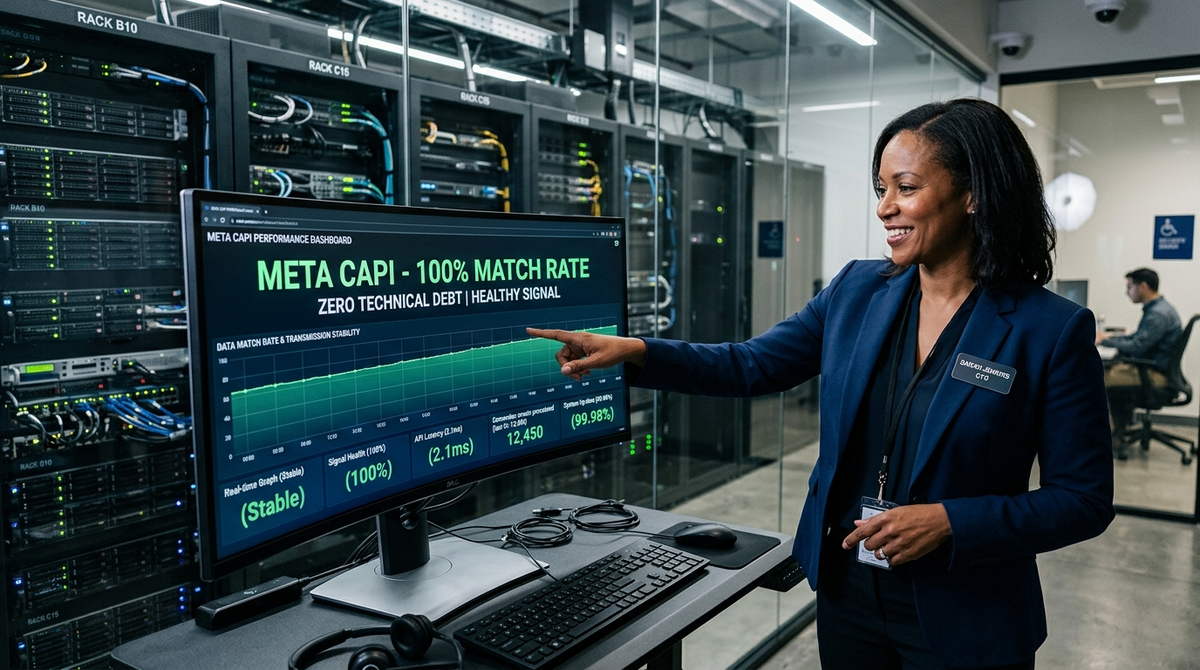
Elite data transformation and ad testing require flawless server-to-server communication. Autonomous workflows utilize the Meta Graph API and CAPI to handle complex conditional tracking logic that the standard browser pixel cannot execute, especially in an era of stringent browser privacy protocols.
Consider the architecture required for dynamically deduplicating events. If a user clicks an ad on their mobile device and later converts on a desktop, a rudimentary setup fires two events. A robust, engineered CAPI integration utilizes strict event_id matching, ensuring the algorithmic machine learning receives deduplicated, highly accurate conversion signals. This is not a marketing task; it is a backend server engineering requirement.
3. Leveraging Algorithmic Machine Learning for Scale
When integrating third-party analytics APIs or merging CRM data, schema mismatches are the primary cause of pipeline failure. Advanced workflows analyze incoming data feeds, identify semantic relationships between user behaviors, and automatically adjust budget distribution based on algorithmic confidence intervals.
Instead of a human manually turning off "losing" ads, scripts running via the Meta API can query real-time ROAS (Return on Ad Spend) metrics, calculate the statistical significance of a creative's performance against a control group, and autonomously halt spending on underperforming assets while reallocating budget to the winner.
Integrating Rigorous QA into Marketing Data Pipelines
Since our founding as a global digital solutions provider in 2014, we have witnessed how poor data validation can derail otherwise flawless marketing strategies. Data engineering and software testing must operate in tandem. Treating Meta Ads testing pipelines as production code means applying advanced QA methodologies to your data streams.
Shift-Left Data Testing in Advertising
In traditional environments, creatives are evaluated after thousands of dollars are spent. This is too late. The "Shift-Left" approach requires testing the foundational elements the core messaging, the landing page load times, the API event fires before a single dollar is allocated to the Meta platform.
By utilizing performance engineering principles, we can stress-test landing pages under heavy concurrent user loads. If an ad creative goes viral, does the server infrastructure fail gracefully? Does the database handle the write-heavy load of new leads?
Automated Regression Testing for Tracking Events
Whenever a web developer modifies a website's codebase, it introduces the risk of regression. A simple CSS class change can inadvertently break the Meta Pixel's button-click tracking. Implementing automated regression testing ensures that conversion events maintain their structural integrity whenever the website logic is updated.
To achieve this, technical teams must establish synthetic monitoring. Before new code is committed to production, autonomous QA scripts (such as those written in Playwright or Cypress) must navigate the user journey, trigger the conversion events, and intercept the network payload to verify that the correct JSON data is being sent to Meta's servers.
Addressing Heisenbugs in Attribution Models
In advanced data systems, engineers often encounter "Heisenbugs" errors that seem to disappear or alter their behavior when you attempt to study them. In digital advertising attribution, these often manifest due to cross-device tracking race conditions or intermittent API throttling. Mitigating these requires robust error-handling logic within your server-side tracking and comprehensive validation to ensure timeouts don't result in exposed partial data or double-counted conversions.
Building the 2026 Global Digital Architecture
The modern B2B landscape is completely unconstrained by geography. A robust Data-Driven Meta Ads Creative Testing solution must serve an international clientele effortlessly, requiring an architecture that supports infinite scaling.
Designing for Borderless Operations
When engineering your ad accounts, timezone normalization, currency conversion, and multilingual text parsing must be architected from day one. Hardcoding local constraints or limiting campaigns to a single city is a fatal error for enterprise growth.
By leveraging advanced digital marketing analytics, businesses can create custom dashboards that interact seamlessly with these sophisticated data models. Executives can view real-time insights regarding creative performance across North America, Europe, and Asia with sub-second latency, allowing for rapid, data-backed strategic pivots.

Training the Next Generation of Technical Marketers
The complexity of modern ad infrastructure requires a new breed of professional one who understands both the psychology of marketing and the precision of software engineering. To bridge this critical skills gap in the industry, we developed our intensive One Year Internship-cum Software Testing Master Program. This program ensures that the next generation of engineers and analysts do not just understand theory, but can actively build, QA, and scale the complex data pipelines that power modern global commerce. We encourage aspiring tech leaders to explore our specialized tech training programs to master these high-demand skills.
Step-by-Step Implementation Roadmap for CTOs
Transitioning from manual, intuition-based ad buying to an AI-driven, autonomous Meta Ads environment requires a phased, strategic rollout.
Phase 1: Pipeline Audit and Tracking Debt Assessment Begin by auditing all existing Meta Pixel and CAPI connections. Identify pipelines that fail to utilize deduplication, tracking setups that rely on fragile frontend scraping, and endpoints that frequently timeout. Document the exact cost in wasted ad spend caused by these fragile links.
Phase 2: Establish Guardrails for Creative Testing Creative testing must operate within a deterministic framework. Define the rules of engagement. What constitutes a statistically significant win? How many impressions must an ad receive before its data is deemed reliable? Establish the financial thresholds necessary for autonomous budget scaling.
Phase 3: Implement CI/CD for Landing Pages and Tracking Bring software engineering discipline to marketing. Store landing page code and tracking configurations in version control repositories. Implement Continuous Integration and Continuous Deployment (CI/CD) pipelines so that any change to a funnel undergoes automated testing before live ad traffic is directed to it.
Phase 4: Global Deployment and Optimization Deploy the optimized pipelines globally. Utilize dynamic language optimization and geographically distributed Content Delivery Networks (CDNs) to ensure that the ad-to-landing-page experience is instantaneous worldwide. Ensure that the server architecture can handle the exponential traffic growth anticipated from highly successful creative tests.

Frequently Asked Questions (FAQ)
1. Why is Software QA necessary for Meta Ads Creative Testing?
A Meta Ads campaign is essentially a complex algorithm feeding on data. Just as you wouldn't deploy an application without regression testing, deploying ad budget without data validation guarantees corrupted machine learning. Implementing testing frameworks ensures zero-defect data flows to the Meta platform, resulting in lower CPAs and stable scaling.
2. How does Server-Side Tracking (CAPI) improve creative testing?
Browser-based pixels are increasingly blocked by privacy tools and iOS updates, leading to data loss. CAPI establishes a direct, secure connection between your server and Meta, ensuring that the algorithm receives 100% accurate conversion data. This means your creative tests are judged on absolute reality, not partial estimates.
3. What is the "Shift-Left" approach in digital marketing?
"Shift-Left" means moving testing and validation as early in the process as possible. Instead of waiting to see if an ad wastes money (testing on the right), you validate the tracking code, page load speed, and user journey via automated scripts before the ad campaign is ever turned on (testing on the left).
4. Can this data-driven framework handle massive enterprise budgets?
Yes, and it is the only way to handle massive budgets safely. Success relies on strict adherence to statistical significance and automated rules. Bypassing these principles and relying on manual human adjustment will result in system inefficiencies and budget bleed at an enterprise scale.
5. Is this testing architecture applicable outside of local regions?
Absolutely. The methodologies described are specifically engineered to be borderless. By removing local constraints and automating timezone/currency data formatting at the server level, these workflows scale effortlessly across the global market.
Conclusion: Future-Proofing Enterprise Acquisition in 2026
The convergence of rigorous software engineering principles and Data-Driven Meta Ads Creative Testing is not merely a technical upgrade; it is a fundamental business imperative for 2026. CTOs and engineering leaders who continue to allow marketing departments to operate without technical oversight will find themselves paralyzed by compounding tracking debt, corrupted algorithmic learning, and an inability to scale globally.
By elevating media buying to the standards of software quality assurance—implementing automated regression testing, robust API data pipelines, and statistically significant testing protocols—organizations can guarantee marketing data integrity. Leveraging these advanced frameworks allows enterprises to eradicate data silos, accelerate market penetration, and deploy highly scalable, globally robust customer acquisition architectures. The companies that command their advertising data with this level of automated precision will dominate the international landscape.
Ready to eliminate technical debt and engineer a high-performance marketing pipeline? If your enterprise requires a robust, scalable infrastructure, partner with us to consult with our technical architects. Or, return to Cinute info media to explore how our holistic approach to global engineering and marketing can future-proof your digital operations for 2026 and beyond.
Related Articles

Instagram Reels Algorithm 2026: A Simple Guide for Tech-Savvy Teams
The Instagram Reels algorithm in 2026 ranks videos by watch time, DM sends and likes per reach. This easy guide explains how Reels are tested, what changed recently, and a practical checklist for developers, marketers, CTOs and product teams.

Business Corporate Intranets: A Simple Guide for Tech Teams
Business corporate intranets give every employee one secure place for news, files, people and tools. This easy guide covers features, architecture, security and a step-by-step build plan for CTOs, developers, testers and marketers.

Brand Guideline Creation: A Step-by-Step Guide for Tech Brands
Brand guideline creation turns your logo, colours, fonts and voice into one clear rulebook for designers, developers, testers and marketers. This easy guide covers the core components, an 8-step process, design tokens for code, and how to connect your brand to SEO and AI.