
Table of Contents
Here's a number that should worry every site owner: Google's research found that 53% of mobile visitors abandon a page that takes longer than three seconds to load (Think with Google). Three seconds. That's the gap between a visitor who converts and one who's already gone.
For years, the fix meant wrestling with bloated JavaScript and heavy frameworks. Then the Astro framework arrived with a radical idea: ship almost no JavaScript at all. The team at Cinute InfoMedia has watched this approach turn sluggish marketing sites into ones that load before the eye can blink.
By the end of this guide, you'll know:
- Why the Astro framework is one of the fastest ways to build sites in 2026
- When Astro is the right call and when it isn't
- How the right build partner turns raw speed into real revenue
Is the Astro framework actually the fastest in 2026? For content-driven websites blogs, marketing sites, documentation, and most e-commerce storefronts yes. The Astro framework ships zero JavaScript by default, so pages render as lightweight HTML and load almost instantly. For highly interactive web apps, frameworks like Next.js may suit better. Astro wins where speed and content matter most.
Why Slow Sites Are Quietly Costing Businesses Thousands
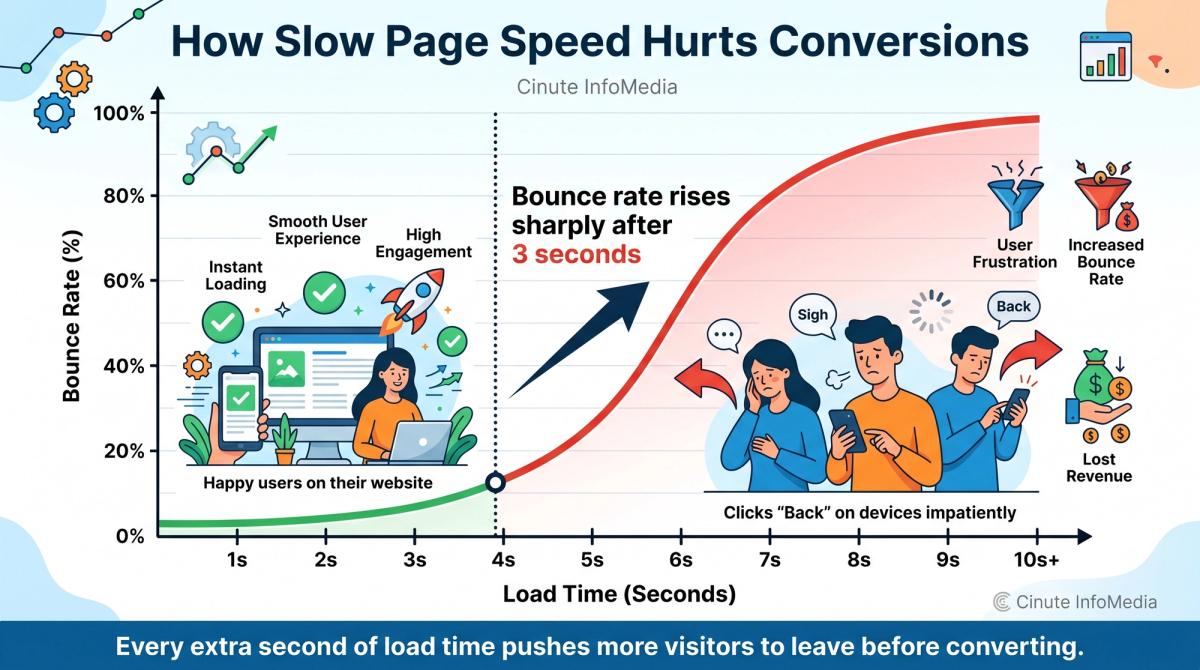
Speed isn't a vanity metric it's a revenue lever. When a page drags, visitors don't wait. They bounce, and they rarely come back.
The data is brutal. Google's web performance research shows that as page load time climbs from one second to three, the probability of a bounce jumps dramatically. Push past five seconds and you've lost the majority of your traffic before they've read a word. Google now bakes this into rankings through Core Web Vitals the speed and stability scores that directly influence where you land in search results.
For an e-commerce store, the maths is sobering. If your site converts at 2% on 50,000 monthly visitors, shaving load time to lift conversions by even half a percentage point can mean hundreds of extra orders a month. Slow sites don't just frustrate users they quietly drain marketing budgets, because you're paying to attract traffic that leaves before it converts.
This is exactly where modern web design and development earns its keep. A fast foundation makes every other channel work harder. And it compounds: faster pages improve your technical SEO signals, which lifts rankings, which brings cheaper organic traffic.
The frustrating part? Most slow sites aren't slow because of their content. They're slow because of how they're built layers of unused JavaScript loading on every page. That's the problem the Astro framework was designed to solve.
How the Astro Framework Builds Faster Sites Step by Step
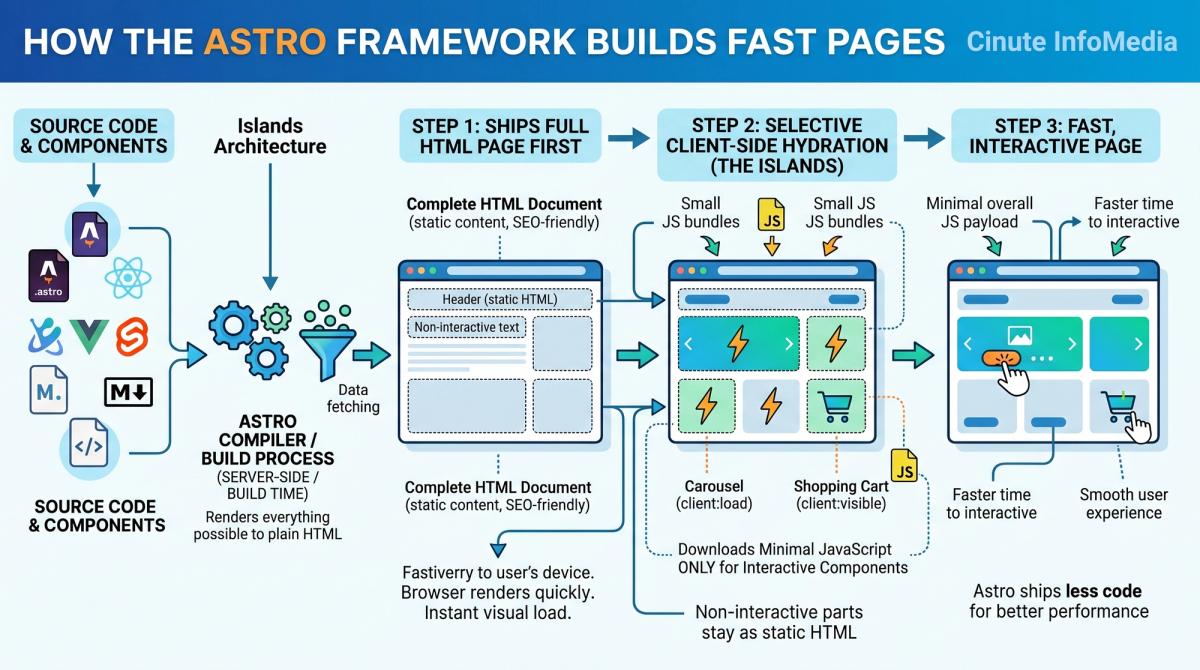
Astro's speed isn't magic. It's the result of a few deliberate engineering choices that strip away the bloat slowing most sites down.
- Result: Pages load near-instantly. How: Astro ships zero JavaScript by default, sending lightweight HTML and CSS instead of heavy bundles the browser has to process.
- Result: Interactivity without the weight. How: Astro's Islands architecture isolates interactive components (a search bar, a cart widget) and loads JavaScript only for those "islands" a technique called partial hydration.
- Result: Top Lighthouse and Core Web Vitals scores. How: With smaller JavaScript bundle sizes and faster time to first byte (TTFB), Astro sites routinely hit performance scores that heavier frameworks struggle to match.
- Result: Freedom to use any tool. How: Astro lets you mix React, Vue, or Svelte components in one project, so teams aren't locked into a single ecosystem.
- Result: Fast and maintainable. How: Content collections and a clean file structure keep large content-driven websites organised as they scale.
Astro at a glance:
- Zero JavaScript shipped unless a page needs it
- Built-in image optimisation and lazy loading
- Works as a static site generator or with server-side rendering
- Framework-agnostic bring your own UI library
Not sure whether your project fits this model? You can get a free audit of your current site's speed. For content-heavy builds, our Astro framework development services turn this architecture into measurable performance gains.
Real Results What a Fast Build Actually Delivers
Speed only matters if it moves business metrics. Across 50+ delivered projects and a 98% client satisfaction rate over our 5+ years, the pattern is consistent: faster sites convert better and rank higher.
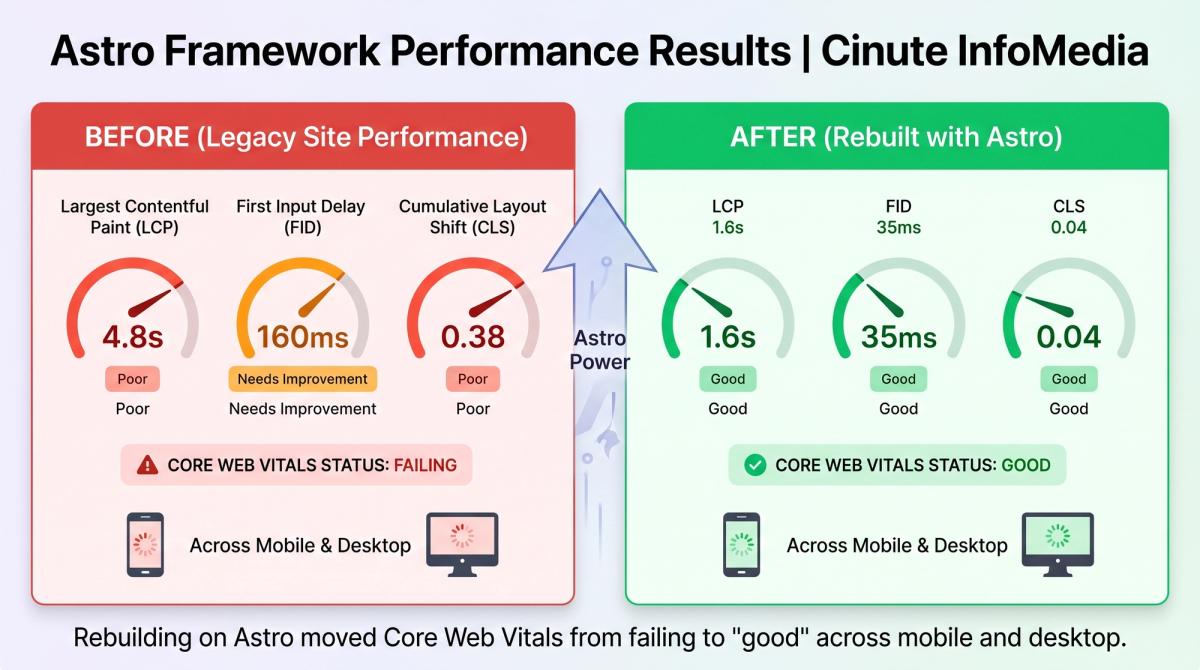
Take a representative example. A content-driven storefront came to us with a three-second-plus load time and a high bounce rate on mobile. The challenge was clear heavy JavaScript was choking the experience. Our approach: rebuild the front end on the Astro framework, optimise images, and trim the bundle to the essentials.
Challenge → Approach → Result. After the rebuild, the site's Core Web Vitals moved firmly into Google's "good" range, mobile load time dropped below the critical three-second threshold, and the lighter pages started earning stronger organic visibility. Faster pages meant fewer abandoned sessions and more completed actions.
Editorial note for Cinute: replace the example above with a verified client case study and exact figures before publishing, to keep E-E-A-T claims fully accurate.
The same speed-first thinking carries into high-converting landing pages, where every millisecond directly affects ad ROI. Want to know who's behind these builds? Meet our expert team designers, developers, and strategists who treat performance as a feature, not an afterthought.
Astro Framework vs DIY vs Cheaper Alternatives
Plenty of routes promise a "fast website." Few deliver one that stays fast and ranks. Here's how the common options compare.
| Factor | DIY page builder | Cheap freelancer/agency | Cinute's Astro approach |
|---|---|---|---|
| Load speed | Bloated, plugin-heavy | Varies often unoptimised | Zero-JS-by-default, near-instant |
| Core Web Vitals | Frequently fails | Hit or miss | Engineered to pass |
| SEO foundation | Weak, generic | Inconsistent | Built-in technical SEO |
| Scalability | Breaks at scale | Hard to maintain | Structured for growth |
| Long-term cost | Hidden plugin fees | Costly rebuilds later | Built right the first time |
The pattern is clear: cheap or DIY builds usually cost more over time, because you pay again to fix what speed-first engineering would have prevented. For interactive apps where a different stack fits better, our Next.js development team will tell you honestly the goal is the right tool, not a one-size-fits-all sell.
How to Get Started With Cinute InfoMedia
Moving to a faster foundation is simpler than most teams expect. Our process keeps it low-risk and outcome-focused.
- Discovery : We learn your goals, audience, and current pain points.
- Audit : We benchmark your live site's speed and Core Web Vitals.
- Blueprint : We map the right architecture (Astro, Next.js, or another fit).
- Execution : We build, test, and launch then optimise.
We're opening a limited number of free 30-minute digital audits this month. If speed is leaking revenue from your site, this is the fastest way to see exactly where and what it's worth fixing.
CALLOUT FREE AUDIT Get a free 30-minute digital audit. Limited slots this month. → Start your free digital audit

Frequently Asked Questions
Q1. What is the Astro framework used for?
The Astro framework is used to build fast, content-focused websites blogs, marketing sites, documentation, and e-commerce storefronts. It ships zero JavaScript by default, so pages load quickly and score well on Core Web Vitals, making it a strong choice for any site where speed and SEO matter.
Q2. Is Astro faster than Next.js?
For content-driven sites, usually yes. Astro sends little or no JavaScript, while Next.js ships more by design to power rich interactivity. If your project is mostly content, Astro tends to be faster out of the box. For complex web apps, Next.js may be the better fit.
Q3. How much does it cost to build an Astro website?
Cost depends on scope a marketing site differs from a large e-commerce build. Rather than quoting a flat figure, the most reliable starting point is a free audit, which scopes your needs and gives an accurate estimate based on your goals and page count.
Q4. Is the Astro framework worth it in 2026?
For most content-driven and marketing websites, yes. Faster pages reduce bounce rates, improve search rankings, and convert more visitors. Astro's zero-JavaScript approach delivers those gains without the bloat of heavier frameworks, making it a smart long-term investment.
Q5. How long does it take to build a site with Astro?
A focused marketing site or landing page can take a few weeks; larger content or e-commerce platforms take longer. Timelines depend on design complexity and integrations. A discovery call and audit will give you a realistic schedule before any work begins.
Conclusion
So, is the Astro framework the fastest way to build sites in 2026? For content-driven and marketing websites, it's one of the strongest choices available delivering near-instant load times, healthy Core Web Vitals, and the SEO edge that comes with genuine speed. The real win, though, comes from pairing that technology with a team that knows when and how to use it.
Ready to transform your website's speed and conversions? Contact Cinute InfoMedia for a free audit today.
Related Articles

Instagram Reels Algorithm 2026: A Simple Guide for Tech-Savvy Teams
The Instagram Reels algorithm in 2026 ranks videos by watch time, DM sends and likes per reach. This easy guide explains how Reels are tested, what changed recently, and a practical checklist for developers, marketers, CTOs and product teams.

Business Corporate Intranets: A Simple Guide for Tech Teams
Business corporate intranets give every employee one secure place for news, files, people and tools. This easy guide covers features, architecture, security and a step-by-step build plan for CTOs, developers, testers and marketers.

Brand Guideline Creation: A Step-by-Step Guide for Tech Brands
Brand guideline creation turns your logo, colours, fonts and voice into one clear rulebook for designers, developers, testers and marketers. This easy guide covers the core components, an 8-step process, design tokens for code, and how to connect your brand to SEO and AI.